


Public Bitcoin miners are increasingly being valued as AI infrastructure companies, but turning that narrative into reality could require roughly $50 billion in near-term capital, according to a new framework highlighted by Blocksbridge Consulting’s latest Miner Weekly newsletter.
Using data from VanEck, the report argues that miners need long-term financing to convert power assets into AI-ready data centers, where higher infrastructure standards translate into much larger capital requirements than traditional Bitcoin (BTC) mining operations.
“A Bitcoin mine can run with relatively simple buildings, modular infrastructure and ASIC fleets that tolerate fast curtailment. AI and HPC facilities require higher standards for uptime, cooling, electrical redundancy, networking and customer support,” Miner Weekly said.
The report follows one of the largest percentage declines in Bitcoin mining difficulty on record, with difficulty dropping 10.09% to 124.93 trillion on June 14 after an estimated 100 exahashes per second (EH/s) of computing power went offline. While weaker mining economics and seasonal power curtailments contributed to the decline, Miner Weekly said the growing shift toward AI infrastructure could reshape future hashrate growth as miners allocate more energy capacity to data centers instead of Bitcoin production.
IREN faces the largest funding gap among public Bitcoin miners pursuing AI infrastructure, requiring an estimated $21.1 billion to fully develop its AI data center ambitions. It’s followed by Riot Platforms, which faces a $7.2 billion funding gap, and HIVE Digital, at $4.6 billion.
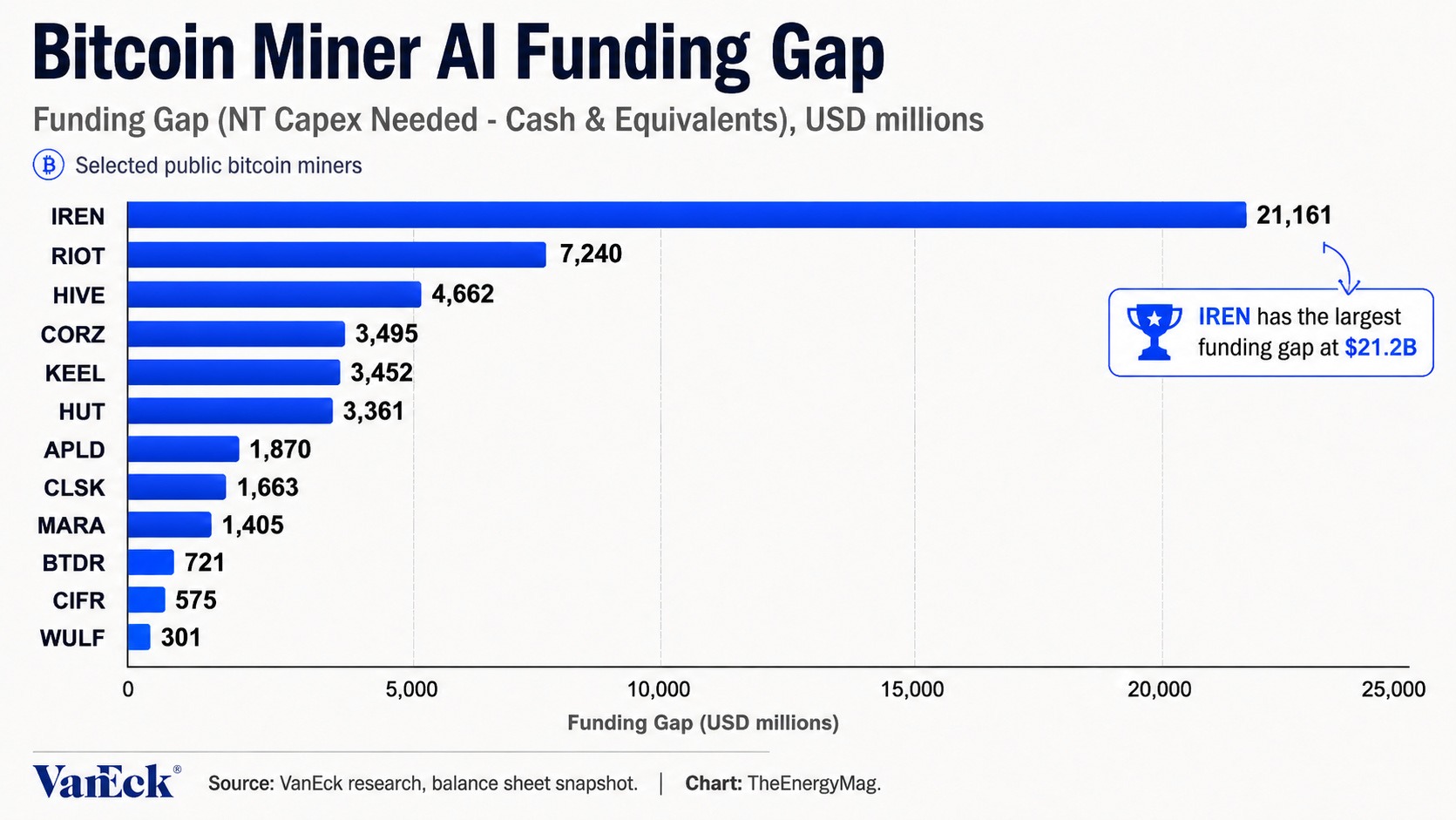
The estimated AI data center funding gap among public Bitcoin miners.
Source: MinerWeekly
To be sure, Bernstein recently flagged IREN as the public miner most likely to abandon Bitcoin mining in favor of AI cloud infrastructure, projecting a $3.7 billion annualized revenue run rate once its AI operations are fully built out.
Related: Bitcoin mining difficulty falls, but is projected to rise in next adjustment
Bitcoin miners face broad economic pressures
Bitcoin mining economics have been under increasing pressure in the two years since the biggest cryptocurrency’s 2024 halving, with lower hashprice and weaker BTC prices squeezing profit margins across the industry.
Hashprice, a measure of the daily revenue earned per unit of computing power, has fallen sharply since Bitcoin reached an all-time high last October. In a December report, TheEnergyMag described the fourth quarter of last year as the “harshest margin environment of all time” for public miners, citing a decline in hashprice to roughly $35 per petahash per second (PH/s).
Conditions deteriorated further in the first quarter, with CoinShares estimating hashprice had fallen to around $28 per PH/s. At those levels, as many as 20% of Bitcoin miners were operating at a loss, particularly those relying on older-generation machines or facing higher electricity costs.
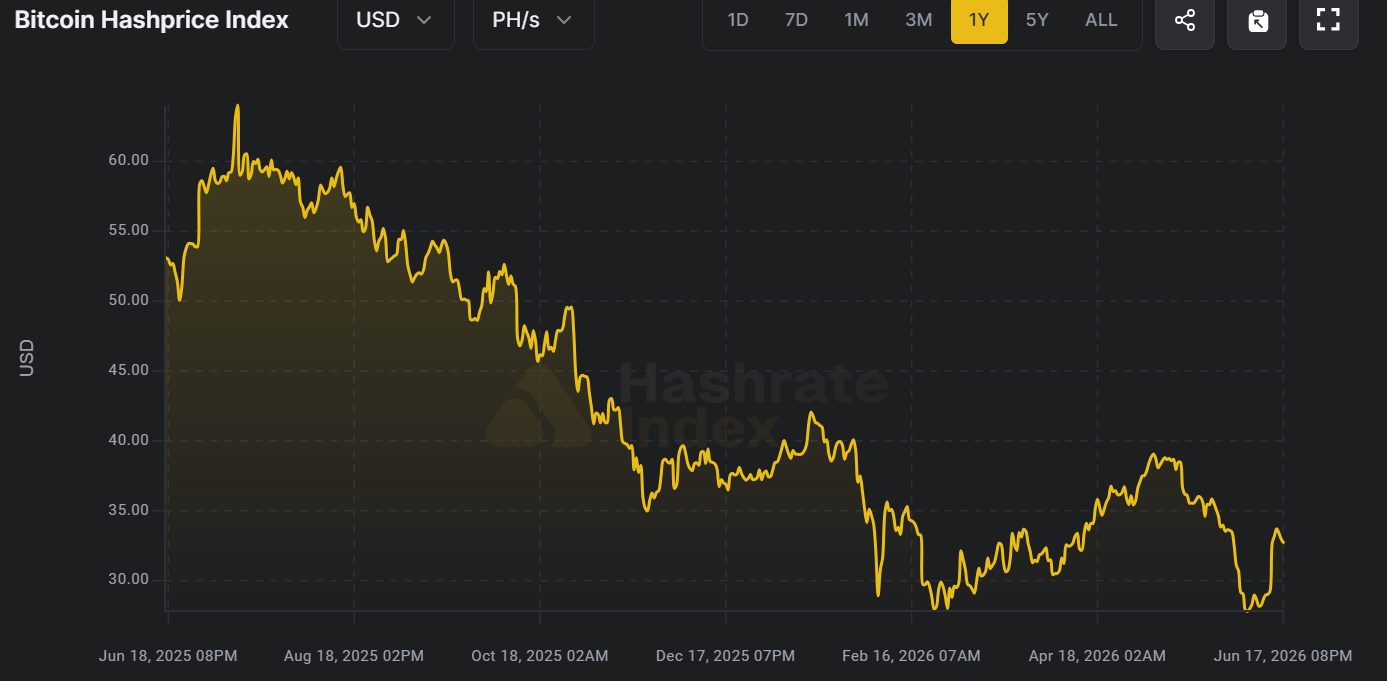
Bitcoin’s hashprice has declined sharply over the past year.
Source: Hashrate Index
Against this backdrop, the AI pivot has become an increasingly attractive strategy for public miners seeking to monetize their power infrastructure through a potentially higher-margin business. The broader AI buildout shows little sign of slowing, with industry bellwether Nvidia reportedly planning a $20 billion bond offering to help finance AI-related investments.
Related: Professional investors dumped 52K BTC worth of ETFs in Q1, filings show
