
Bitcoin’s blockchain is showing its strongest activity since late 2024, creating a rare split between rising network use and a weakening market price.
CryptoQuant said in a note shared with CryptoSlate that its Bitcoin Network Activity Index has moved above its long-term trend for the first time since mid-2024.
The index has climbed steadily since January and recently reached its highest level since late 2024, leaving it only about 7% below the record reached in September 2024.
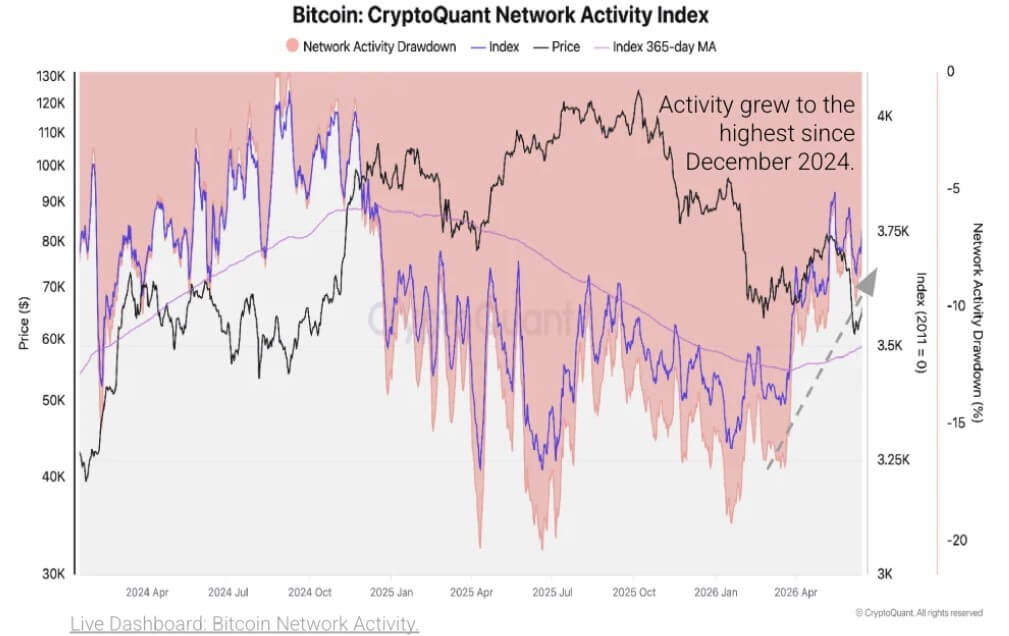
The shift began in late March and has held for several weeks, suggesting that the rebound in activity is more than a one-day spike.
Meanwhile, the rise in network activity comes as the Bitcoin price remains under significant selling pressure.
The largest cryptocurrency has fallen about 30% this year to below $65,000, according to CryptoSlate data, extending a slide of more than 50% from its late-2025 record near $126,000 as months of selling pressure and weaker risk appetite weigh on the market.
Small transfers drive the rebound
The network rebound is being driven mainly by transaction counts rather than large-value settlement.
CryptoQuant data shows total daily Bitcoin transactions rising above 800,000 at points in 2026, near the strongest readings of the 2023-2025 cycle and more than double the lows seen in 2025. Average transactions per block have also climbed, showing sustained block use from a transaction-count perspective.
The composition of that activity is the more important part of the story.
Transactions worth less than 0.01 BTC now account for about 80% of daily Bitcoin transaction counts, CryptoQuant said. That is up from roughly 44% in 2023.
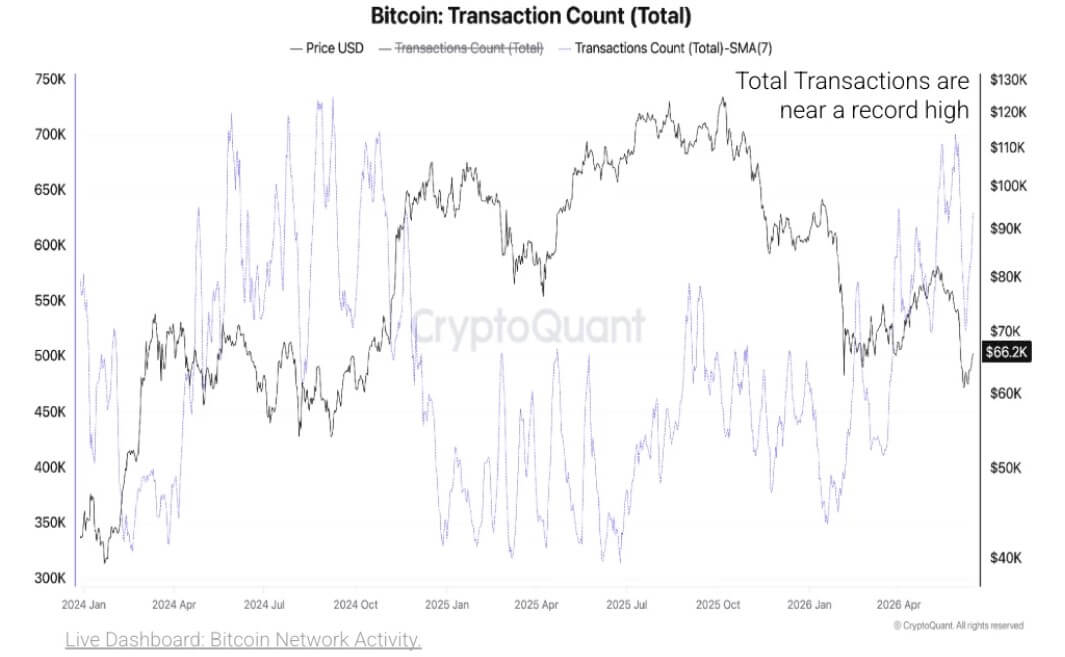
The smallest cohorts, including transactions below 0.001 BTC and below 0.01 BTC, have surged this year and are approaching the previous peak reached in 2024.
That means Bitcoin’s network is busier, but much of the growth is coming from very small transfers. In market terms, the blockchain is processing more messages, but not necessarily moving proportionally more economic value.
The pattern resembles prior bursts of protocol-driven activity on Bitcoin, when token experiments, inscriptions, and data services increased transaction counts without matching the value profile of traditional BTC transfers.
OP_RETURN use points to data-heavy demand
The rise in small transfers has coincided with a sharp increase in OP_RETURN usage.
OP_RETURN is used to attach data to Bitcoin transactions without creating spendable outputs. That has made it a common tool for data-layer activity on Bitcoin, including token-related transfers, timestamping, and inscription-adjacent use cases.
CryptoQuant said OP_RETURN outputs have climbed to near-record levels this year, with the increase linked to activity from Runes, Ordinals, BRC-20-style markets, and other data-writing services.
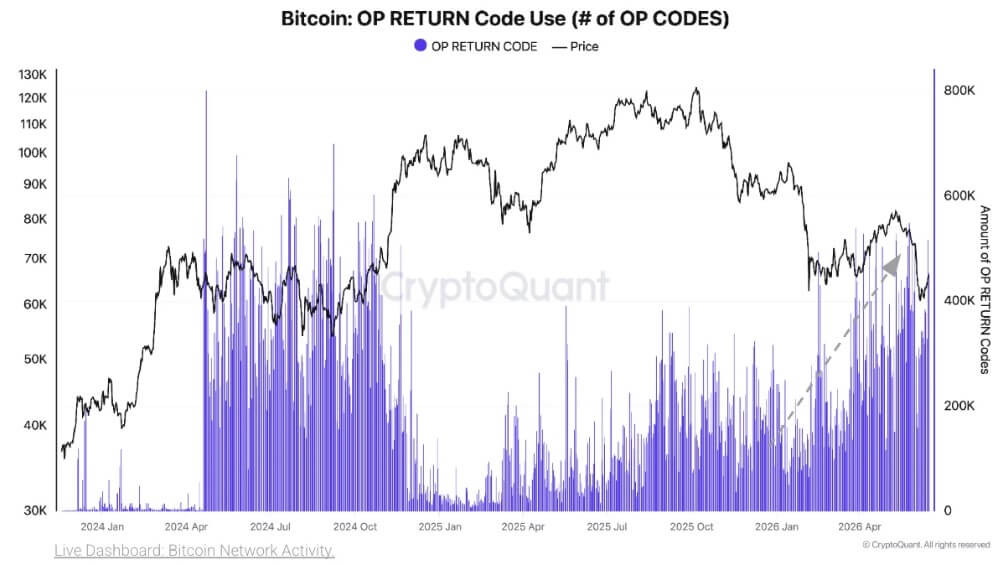
These systems can generate large numbers of low-value transactions because the economic payload is often the data attached to the transaction rather than the amount of BTC being transferred.
That helps explain why the network activity index is rising while the price remains weak. The new activity reflects demand for Bitcoin block space, but it is not the same thing as a broad recovery in investor appetite for BTC.
It also complicates the long-running debate over Bitcoin’s use case. Supporters may view the surge as evidence that Bitcoin is becoming a more active settlement layer for new types of on-chain activity.
However, critics may see it as congestion from transactions that do little to support Bitcoin’s monetary role.
For now, the data supports both readings to some degree. Bitcoin is being used more. But the use is concentrated in small transactions that differ from the financial transfers many investors associate with durable network demand.
Mempool congestion returns, but fees stay low
The jump in micro-transactions has started to affect the mempool, where unconfirmed Bitcoin transactions wait before being added to blocks.
CryptoQuant said the Bitcoin mempool transaction count has risen to about 128,000, the highest since late February 2025. The congestion is concentrated in low-fee transactions, consistent with the increase in OP_RETURN and micro-transaction activity.
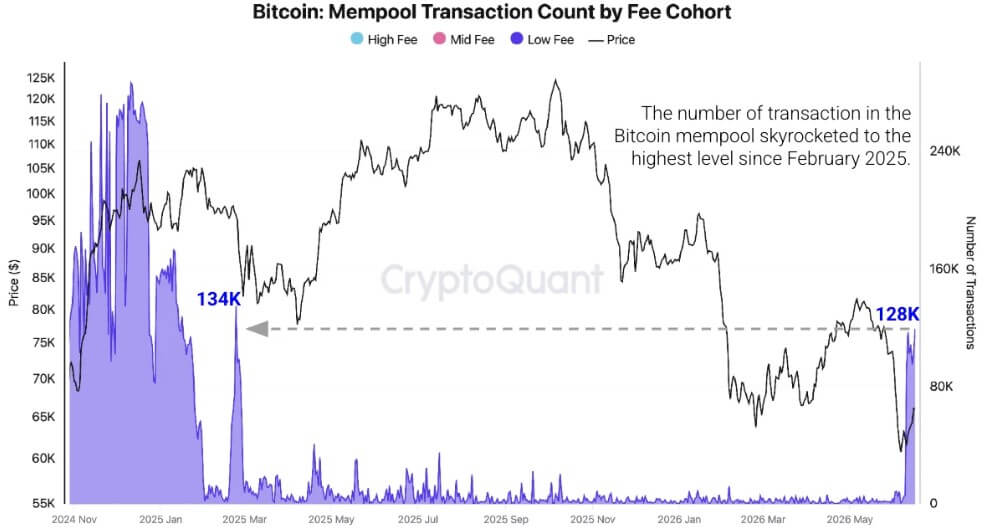
The current backlog remains well below the extreme peaks seen in September 2023 and November 2024. Still, the increase shows that non-financial or low-value activity is taking up a larger share of Bitcoin transaction flow.
That could become more important if the trend continues. Higher competition for block space can push up fees, especially for users who need time-sensitive settlement.
In past cycles, congestion from inscriptions and token-related activity created brief periods of elevated fees and renewed debate over whether Bitcoin’s block space should be used primarily for monetary transfers or broader data applications.
So far, the latest activity burst has not produced a comparable fee boom.
YCharts data, based on Blockchain.com figures, showed daily Bitcoin transaction fees at 3.458 BTC on June 18, down 50.25% from a year earlier.
BitInfoCharts also shows average Bitcoin transaction fees at low levels, with the average fee recently near 27 cents.
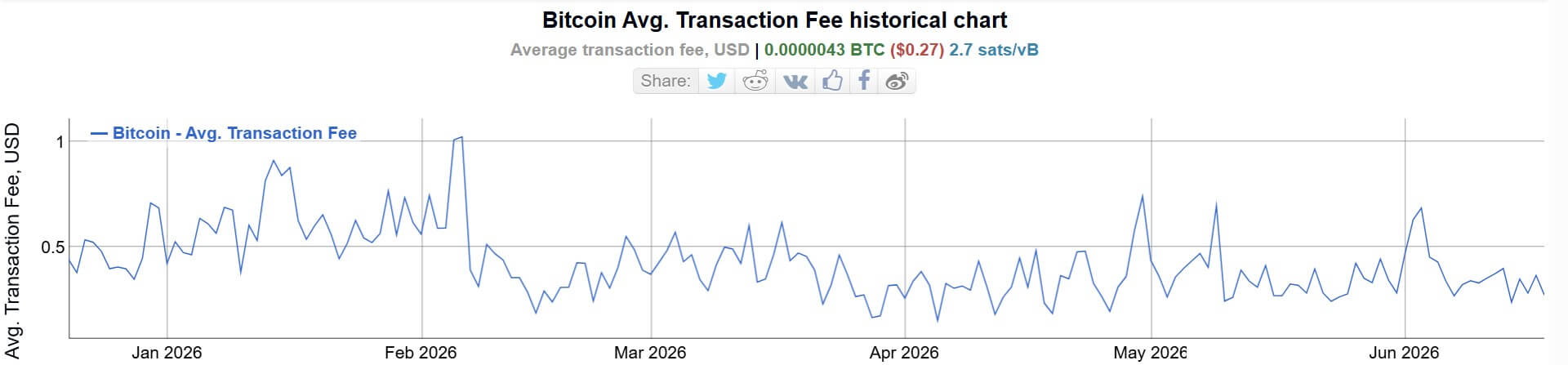
That gap is central to the current story. Transaction counts are rising, but the fee market has not followed with the same force.
Miner revenue remains the weak link
The muted fee response matters because Bitcoin miners have relied more heavily on transaction fees since the April 2024 halving cut the block subsidy to 3.125 BTC.
At roughly 144 blocks a day, the subsidy remains the main source of miner revenue. Fees contribute only a small share in BTC terms when network costs are low, limiting the direct financial benefit miners receive from higher transaction counts.
That makes the current activity surge less straightforward than prior periods when congestion produced large fee spikes. More transactions can signal stronger demand for block space, but if those transactions are low-value and low-fee, the impact on miner economics remains limited.
The result is a mixed signal for the Bitcoin market.
On one hand, the blockchain is seeing its strongest activity in nearly two years, driven by real demand for small transactions and data-linked use cases.
On the other hand, Bitcoin’s price remains under pressure, sellers still dominate the short-term market structure, and the fee market has not shown that users are willing to pay significantly more for settlement.
That leaves Bitcoin with a busy network but an unresolved market question: whether this new wave of activity can become durable economic demand, or whether it remains another burst of low-value traffic that fills blocks without changing the broader investment picture.
