

The US Treasury’s Office of Foreign Assets Control revoked General License X on July 7, cutting off the authorization that had allowed Iranian crude oil, petrochemical, and petroleum-product transactions through Aug. 21.
Its replacement, General License X1, permits only wind-down transactions through 12:01 a.m. ET on July 17.
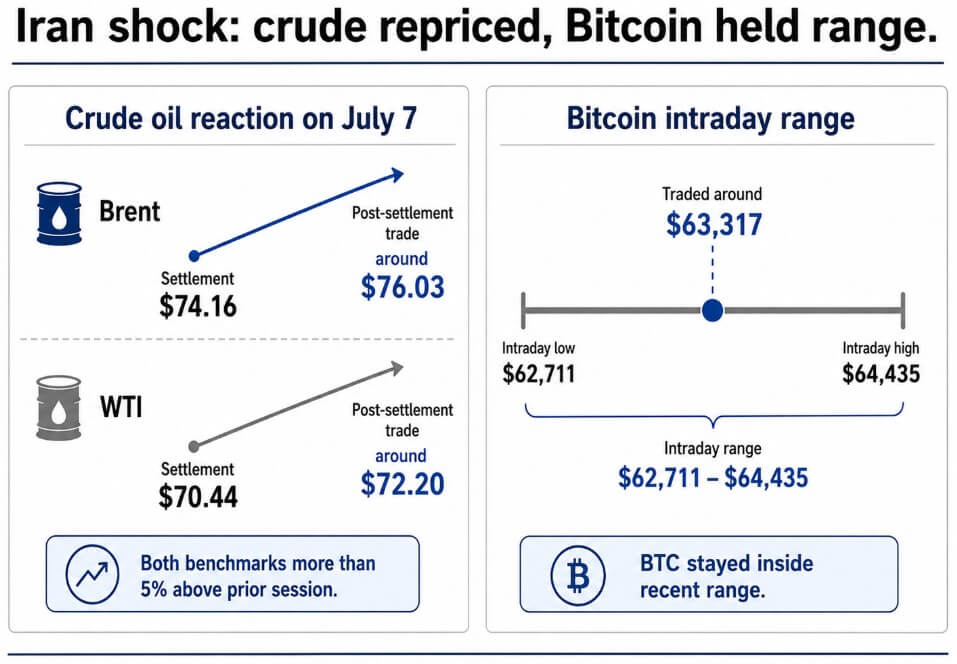
Brent crude settled at $74.16 and WTI at $70.44 that day, then extended gains in post-settlement trade to about $76.03 and $72.20, putting both benchmarks over 5% above the prior session.
Tanker attacks near the Strait of Hormuz drove that move, and maritime authorities raised transit risk through the strait to severe, with US officials warning of further consequences.
Bitcoin absorbed the same news near $63,317, trading within an intraday range of $62,711 to $64,435. A market that pushed crude more than 5% higher on renewed Middle East risk left Bitcoin inside a band it has occupied for weeks.
That gap leaves open the question of whether Bitcoin’s calm reflects confidence that the oil shock fades, or a lag before the shock shows up in the data Bitcoin trades on.
The clock behind the headline
The July 17 wind-down turns the announcement into a market clock, giving traders roughly 10 days to see whether Iranian barrels, Hormuz shipping flows, and US-Iran diplomacy settle down before the deadline hits, or whether the deadline itself becomes the next flashpoint.
The EIA says the strait handled about 20 million barrels per day in 2024, roughly 20% of global petroleum liquids consumption, with few alternative routes available if flows through it are disrupted.
Crude can carry a disruption premium well before the strait is confirmed closed, and that premium is already moving Brent and WTI.
The Cleveland Fed’s inflation-nowcasting model treats gasoline as a direct input to headline CPI and PCE forecasts, and its gasoline nowcasts are derived from oil prices. That link gives a crude path into the inflation data the Fed watches most closely, independent of anything else happening in the economy.
EIA data put US regular gasoline at $3.777 per gallon for the week of July 6, down from $4.146 per gallon on June 8 and still $0.652 per gallon above the same week a year earlier.
Crude oil accounted for 57% of the March 2026 regular gasoline price, according to EIA’s cost breakdown, giving pump prices direct exposure to crude price moves, even though retail pass-through also depends on refining, distribution, taxes, and timing.
| Channel | Data point to watch | Why it matters for Bitcoin |
|---|---|---|
| Strait of Hormuz risk | Shipping flows, tanker attacks, insurance costs, July 17 wind-down | Determines whether crude carries a durable disruption premium. |
| Crude oil | Brent and WTI holding gains after the initial shock | Sustained crude gains raise the odds that gasoline relief stalls. |
| Gasoline | Weekly EIA pump prices | Gasoline is a direct, visible path into headline inflation pressure. |
| CPI / inflation expectations | June CPI release on July 14, inflation expectations, breakevens | Sticky inflation reduces the Fed’s room to ease. |
| Fed path | July 28–29 FOMC, yields, dollar | Higher-for-longer policy can weaken Bitcoin liquidity support. |
| Bitcoin | BTC holding or breaking the $62,711–$64,435 range | Shows whether traders still treat the shock as contained. |
What Bitcoin’s calm could be worth
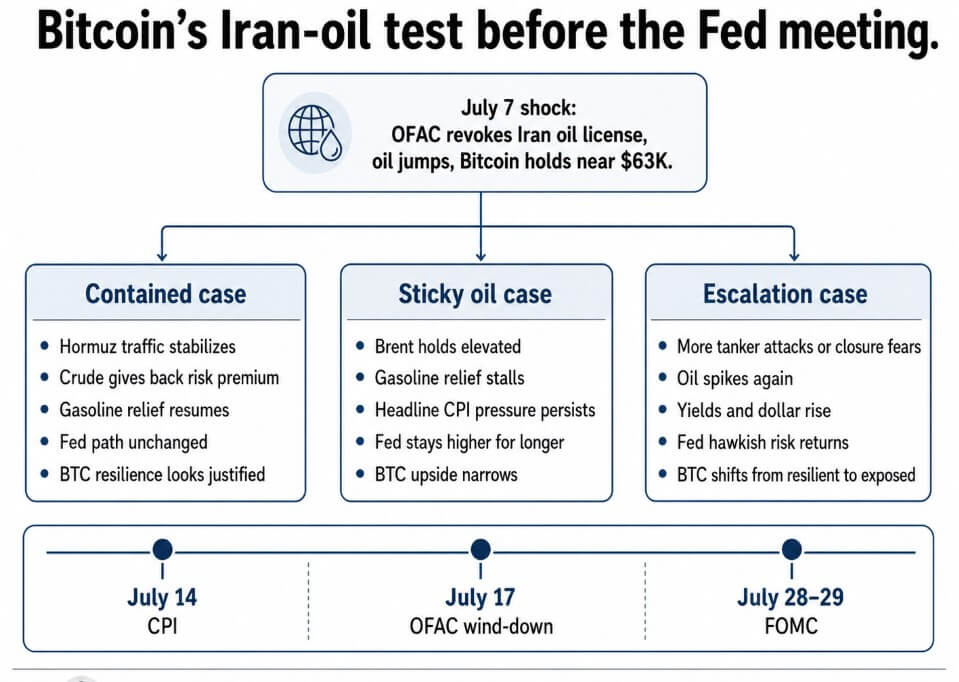
The calendar compresses three separate events into three weeks: the Bureau of Labor Statistics releases June CPI on July 14 at 8:30 a.m. ET, the OFAC wind-down expires July 17, and the Federal Reserve’s next policy meeting runs July 28-29, placing the Fed’s decision date behind both the inflation print and the wind-down deadline.
The Fed already treats energy as a live input into its outlook, with its June 17 statement keeping rates at 3.50%-3.75% and citing supply shocks, including energy, among the reasons inflation stayed elevated relative to its 2% goal.
Nine of the Fed’s 19 policymakers saw a 2026 rate hike in the June projections, up from zero three months earlier, as oil-driven inflation risk pulled the internal debate away from cuts.
In the contained case, Strait traffic stabilizes, and crude gives back its risk premium over the next 10 days.
Gasoline relief resumes; the June CPI release on July 14 shows inflation pressure before the latest oil shock was still contained, and Bitcoin’s flat reaction to this week’s headline reads, in hindsight, as the market correctly pricing a shock that faded before it reached consumers.
In the sticky case, Brent holds in the range UBS has flagged between $70 and $100, depending on how quickly Hormuz traffic normalizes, or climbs toward the $110 to $120 range HSBC has modeled if flows stay constrained for months.
Gasoline relief stalls in that scenario; inflation expectations and breakevens carry the energy shock into the Fed debate, and later-July inflation data become the first fuller test of whether crude costs have reached consumers. Fed policymakers, already split on a possible 2026 hike, have more reason to hold rates or lean hawkish.
Bitcoin’s liquidity support narrows as yields and the dollar firm together, and the calm this week gives way to a market repricing the same headline as a Fed problem.
Bitcoin’s flat price action this week shows traders treating the Iran shock as background risk so far. The three-week window between July 7 and the July 28-29 FOMC meeting decides whether that reaction holds.
Every link in the chain from Hormuz to gasoline to CPI to the Fed still needs confirmation in the data before the sticky case can take hold.
Whether the oil shock prices into Bitcoin depends on the June CPI release, the July 17 wind-down deadline, and the July 28-29 Fed meeting.
