


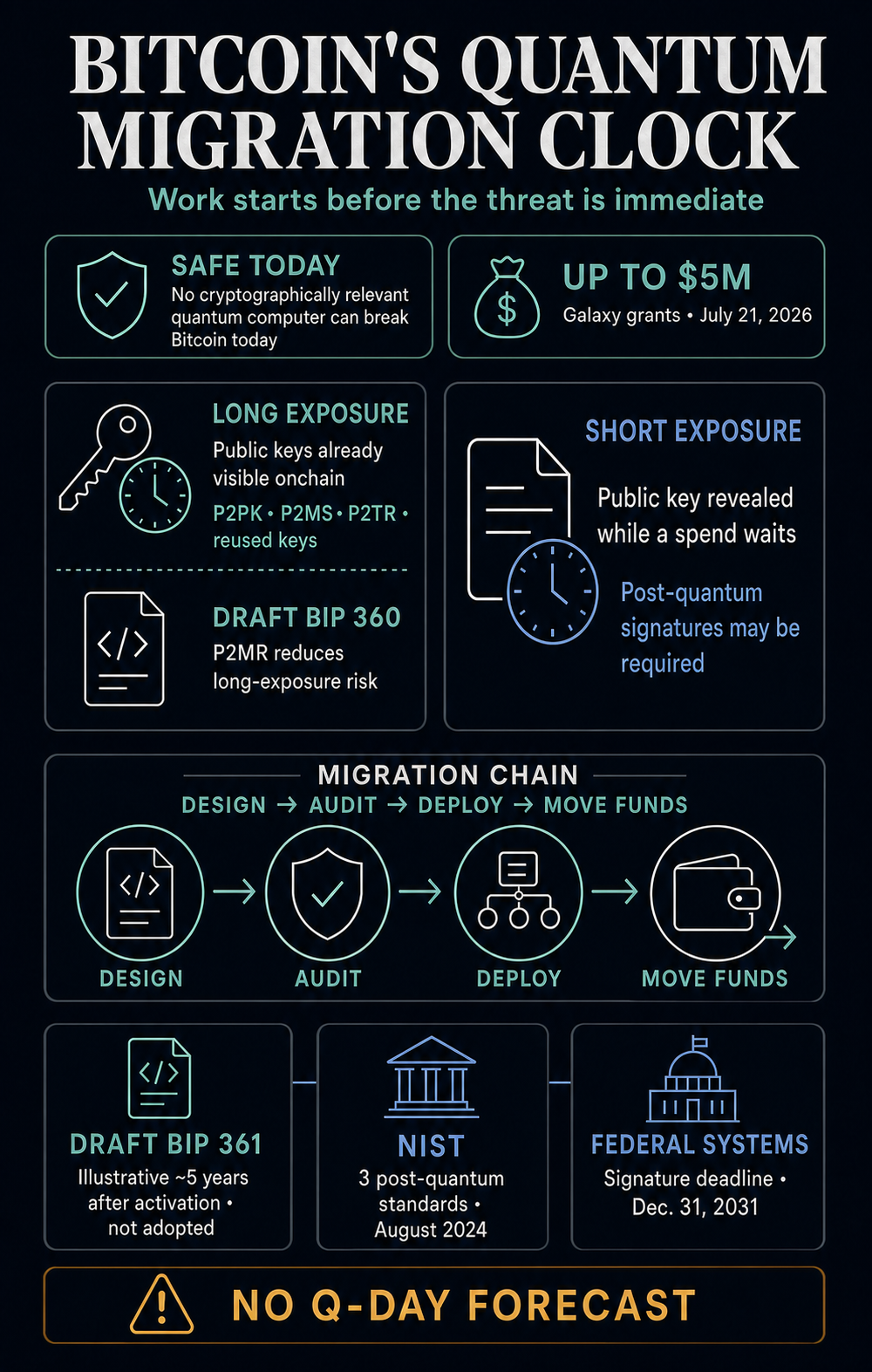
Galaxy Digital pledged up to $5 million on July 21 to help Bitcoin prepare for the quantum era. The initiative will back developers as they reach key milestones, while supporting research and a Quantum Advisory Council.
Quantum computers cannot crack Bitcoin’s signature security today, but the program aims to get migration work moving before that threat becomes real.
The initiative targets several links in the transition chain: review of quantum-resistant transaction proposals, post-quantum signature integration, formal security audits, and software and institutional migration tools.
Funding can accelerate those workstreams, but Bitcoin’s decentralized governance still requires developers, miners, node operators, wallets, exchanges, custodians and users to coordinate an upgrade that Galaxy says could take years to design, test and deploy.
The technical risk has two windows. A sufficiently powerful quantum computer could use Shor’s algorithm to recover a private key from an exposed elliptic-curve public key and forge a valid signature. Keys already visible onchain give an attacker a long window. Most Bitcoin spends also reveal a public key while the transaction waits in the mempool, creating a shorter window for a faster attack.

Draft BIP 360 identifies pay-to-public-key, bare multisignature and Taproot outputs among those exposed for long periods. Address reuse, extended public keys, and wallet descriptors can also reveal vulnerable material. Hash-protected outputs keep the public key hidden until spending or another disclosure.
BIP 360 would use a soft fork to add a new Pay-to-Merkle-Root output. Known as P2MR, it drops Taproot’s key path, limiting long-term exposure and leaving room for stronger signature schemes later.
The proposal remains a draft and covers only the first exposure window. Defending a transaction after its key appears in the mempool may require post-quantum signatures.

That is where Galaxy’s grant program could help move research into reviewed code and migration tooling, but funding cannot select Bitcoin’s final design or schedule its adoption.
A second proposal, BIP 361, illustrates the operational scale. The draft informational BIP depends on a still-unspecified post-quantum signature proposal and sketches a roughly five-year, two-phase transition after activation. Its timetable is one scenario, not an adopted roadmap.
After a design is chosen, the network would still need proposal and signature review, audits, wallet and node releases, institutional upgrades, and holder migration. Users need time to move funds into protected outputs while existing signatures remain safe to use. Each dependency makes a last-minute response harder.
Broader cryptography programs already work on multi-year horizons. NIST finalized three post-quantum standards in August 2024, including two for digital signatures, and urged early integration because migration takes time. Executive Order 14412 directs the Office of Management and Budget to require specified federal systems to use post-quantum signatures by Dec. 31, 2031.
Those federal rules cover only government systems and do not predict when quantum hardware will arrive. But they show why Galaxy is starting early. Bitcoin still needs a thoroughly reviewed signature design, broad community agreement, and enough time for users to move their funds, so the research and tools cannot wait until the threat is at the door.
