


US-listed spot Bitcoin and Ethereum exchange-traded funds pulled in more than $1 billion in fresh cash this week, with both groups registering their strongest inflows since April as demand for regulated crypto investment products rebounded.
Data from SoSoValue shows that spot Bitcoin ETFs attracted $853.54 million during the week ended Aug. 7, their biggest haul in nearly four months.
The funds recorded inflows in every session, including $170.09 million on Monday, $211.49 million on Tuesday and $244.42 million on Wednesday before demand moderated toward the end of the week.
The total surpassed the roughly $824 million collected during the week of April 24 and was the strongest since the week ended April 17, when Bitcoin funds drew about $996 million.
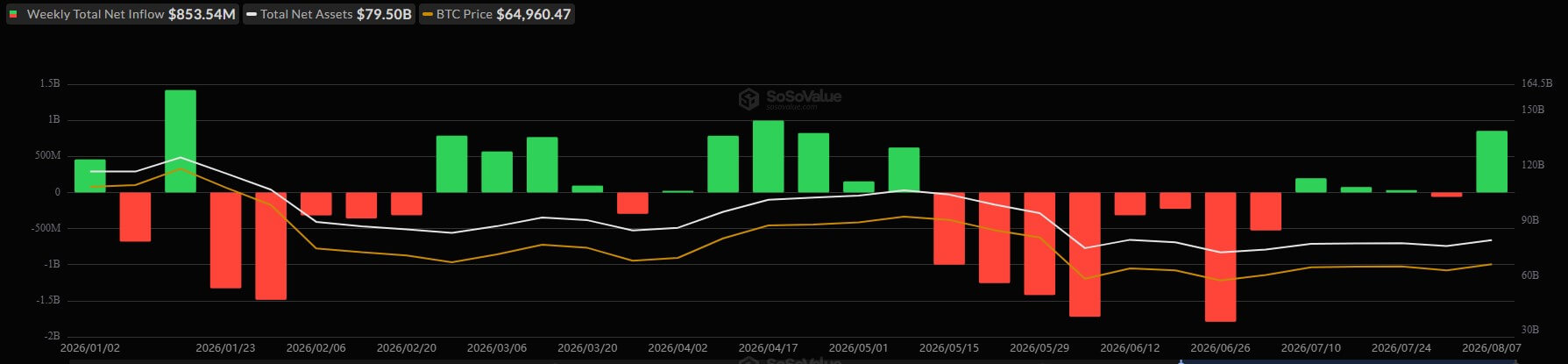
BlackRock’s iShares Bitcoin Trust, or IBIT, dominated the latest inflow week, accounting for roughly $693 million of the weekly total. That means the world’s largest asset manager captured more than four-fifths of the new money entering the spot Bitcoin funds.
These inflows add to the scale the products have amassed since their landmark US debut in January 2024. The group has recorded more than $52 billion in cumulative net inflows and now oversees about $80 billion in net assets.
Coldcard hack puts custody back in focus
The renewed demand arrived days after disclosures of a security flaw affecting Coldcard hardware wallets, adding a custody backdrop to the ETF rebound.
Researchers at TRM Labs estimated that attackers drained roughly 1,816 BTC, worth about $116 million, from more than 5,200 addresses beginning July 30. Other estimates have placed losses around $130 million as researchers continue to trace the thefts.
Bloomberg Intelligence ETF analyst Eric Balchunas pointed to the timing of the fund flows following the Coldcard losses, while stopping short of claiming that affected self-custody investors had moved directly into ETFs.
He argued that the breach could strengthen the case for institutional custody among investors whose primary objective is long-term Bitcoin exposure rather than using the asset for transactions or censorship-resistant payments.
For those investors, Balchunas said the security infrastructure behind large financial institutions could become increasingly difficult to dismiss after a failure involving hardware designed specifically to keep Bitcoin outside the traditional financial system.
There is no evidence yet that the Coldcard breach directly caused this week’s ETF inflows. The timing, however, puts the trade-off between self-custody and institutional custody back into focus just as regulated Bitcoin funds are seeing their strongest demand in months.
Ethereum ETFs extend five-week comeback
Ethereum-focused ETFs also staged an even sharper improvement, collecting $244.94 million for their strongest week since April and extending their run of weekly inflows to five consecutive periods.
The run has now brought roughly $566 million into the products and represents their longest weekly inflow streak this year. It is also their longest since a 14-week run between May and August 2025 that attracted nearly $10 billion.
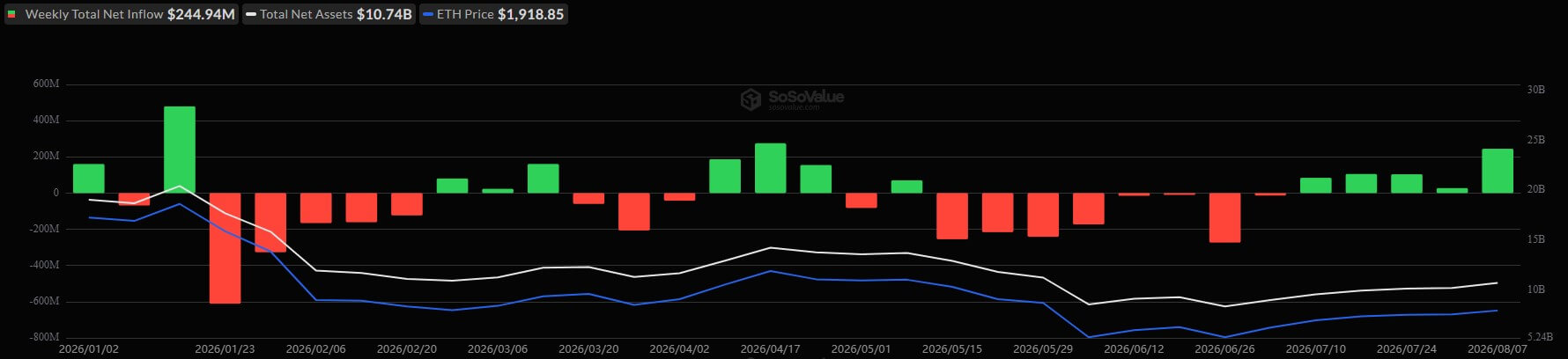
Unlike Bitcoin funds, the Ethereum ETFs started the week in negative territory, recording $11.42 million of net outflows on Monday.
Demand reversed sharply thereafter. Investors added about $53.75 million on Tuesday, $60.86 million on Wednesday and $92.15 million on Thursday, while another $49.60 million entered the products on Friday.
BlackRock again accounted for most of the buying. Its iShares Ethereum Trust, or ETHA, attracted roughly $203 million during the week, equivalent to more than 80% of the category’s total inflows.
The concentration means the strongest week for both Bitcoin and ETH ETFs since April was largely a BlackRock story. IBIT and ETHA together absorbed about $896 million, or more than four-fifths of the nearly $1.1 billion that flowed into the two groups.
That renewed demand marks a sharp improvement from the weaker flows that characterized much of the summer, while giving both crypto assets their clearest sign in months that investors are rebuilding exposure through Wall Street’s regulated vehicles.
