

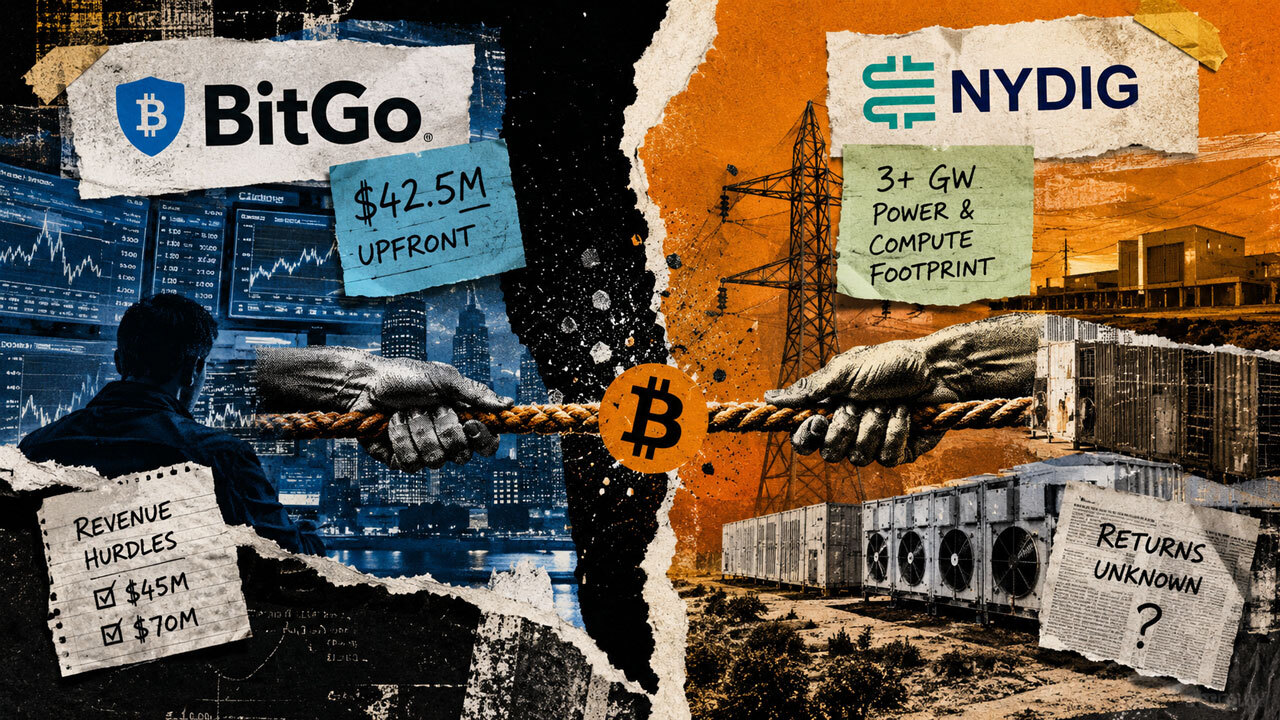
BitGo’s NYDIG deal transfers its institutional trading business to the digital-asset custody and trading infrastructure provider, while NYDIG says it is concentrating resources on power, Bitcoin mining and high-performance-computing data centers.
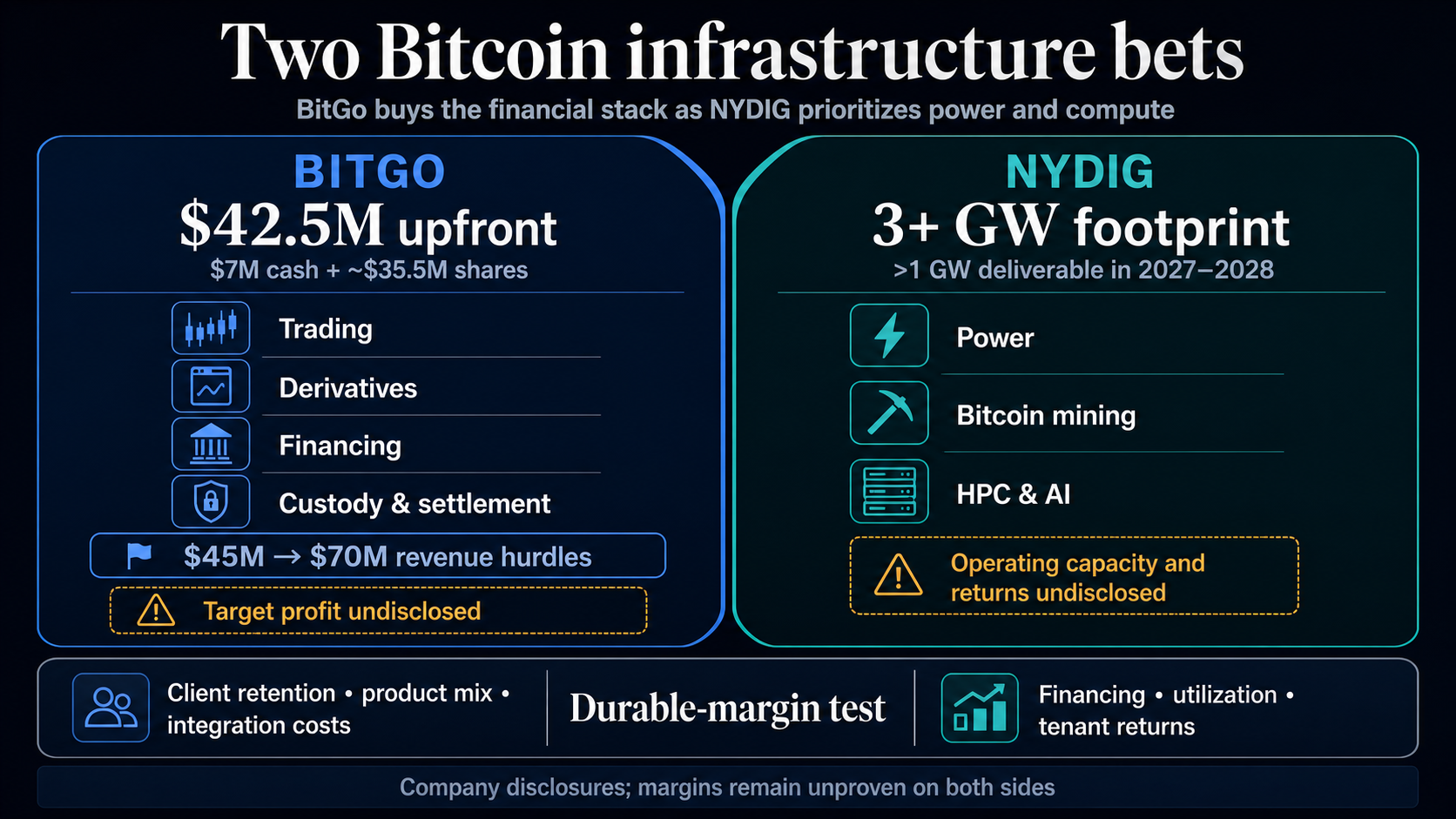
The closing terms disclosed by BitGo put roughly $42.5 million of consideration upfront. BitGo is adding an institutional team, client relationships and financial products around its custody and settlement platform. NYDIG is directing attention toward a company-described power-and-compute footprint exceeding 3 GW.
The deal makes each company’s resource allocation clear while leaving the margin comparison unresolved. BitGo’s filings show that very large digital-asset sales can carry a thin gross spread. NYDIG describes a large infrastructure footprint without disclosing the returns attached to it. The useful comparison is between the proof points each side must deliver.
What the BitGo NYDIG deal discloses, and leaves unresolved
The merger agreement defines the acquired business as spot and derivatives trading, virtual-currency asset management, borrowing and lending, and loan servicing. It explicitly excludes NYDIG’s Bitcoin mining and custody businesses, keeping the power-and-compute footprint outside BitGo’s purchase.
Approximately 30 NYDIG employees and institutional client trading relationships joined BitGo, according to the deal announcement. The team adds derivatives, structured products, financing and capital-markets capabilities to a platform that already offers institutional custody, trading and settlement.
The upfront consideration consists of $7 million in cash, subject to holdback and adjustments, plus 5,933,577 BitGo shares. The agreement uses a $5.9829 reference price, which values those closing shares at about $35.5 million and brings the disclosed upfront amount to roughly $42.5 million before cash adjustments.
The seller can receive more. A first earn-out pays $10 million in cash. A second provides $5 million in cash plus 835,715 BitGo shares, worth roughly another $5 million at the agreement reference price. Separate awards targeting $10 million are intended for transferred employees rather than the seller, so they sit outside the seller’s purchase price.
Those earn-outs are tied to trailing-12-month revenue hurdles of $45 million and $70 million through February 2028. The thresholds create a visible growth test for the acquired business. Expenses tied to reaching either mark remain undisclosed, leaving profitability and any margin improvement for later results to establish.
| What is disclosed | What remains undisclosed |
|---|---|
| Roughly $42.5 million of upfront consideration before cash adjustments | The target’s historical revenue, direct costs and operating profit |
| $45 million and $70 million trailing-12-month revenue hurdles | The cost and margin attached to reaching either hurdle |
| The acquired services, approximately 30 employees and client relationships | The target’s asset contribution and integration costs |
| NYDIG’s claimed 3+ GW footprint and 2027-2028 delivery goal | How much capacity is operating, contracted or financed and at what return |
A revenue-based earn-out rewards scale more directly than efficiency. BitGo can meet its disclosed growth tests while still facing integration, compliance, technology and financing costs. Investors will need later filings to connect any acquired revenue to profit and to distinguish organic growth from activity transferred with the NYDIG client book.
BitGo’s existing spread is context, not a target proxy
BitGo’s second-quarter filing offers one reason the company may want more products around institutional trading. Its Digital Asset Sales line generated $4.197517 billion of revenue against $4.190435 billion of direct cost in the three months ended June 30. The $7.082 million difference equals about 16.9 basis points of that revenue line.
BitGo’s consolidated margin is a separate measure. The company says it presents most digital-asset sales on a gross basis because it acts as principal, which puts both the asset sale and the corresponding direct cost through revenue and expenses. The accounting produces billions of dollars of reported sales even when the difference between the two lines is comparatively small. BitGo separately recorded a $19.025 million consolidated net loss for the quarter.
The timing and scope prevent those figures from being assigned to the acquisition. The quarter ended before BitGo announced the completed transaction on Aug. 27. The public filings do not disclose the target unit’s historical revenue, profit, asset contribution or cost structure, and its derivatives, financing and lending activities may have a different revenue-recognition pattern from BitGo’s existing Digital Asset Sales line.
The 16.9-basis-point figure warns against equating gross transaction volume with durable economics. Target margins, acquisition accretion and any change in BitGo’s overall revenue mix require separate post-deal disclosures.
BitGo’s strategic case is that a broader set of trading, financing and structured products can deepen relationships across custody and settlement. The company described that as greater asset stickiness. The thesis becomes measurable when later disclosures show revenue contribution, integration costs and whether clients adopt several services without pushing risk or operating expenses up just as quickly.
Those disclosures will also need to separate the effects of the acquired client book from BitGo’s pre-existing trading activity. Higher revenue could otherwise reflect more gross principal volume rather than better pricing, higher-value services or improved profitability.
NYDIG is putting its scarcity thesis in power
NYDIG’s Power & Compute page says the company owns generation assets, grid positions and data-center halls supporting high-performance computing, AI training and inference, and Bitcoin mining. It describes a North American footprint exceeding 3 GW.
The acquisition announcement says more than 1 GW is deliverable in 2027 and 2028. These are company statements about footprint, pipeline and timing. Current online capacity remains unspecified, along with contracted capacity, tenant revenue, construction cost, financing cost, utilization and project returns.
NYDIG’s direction predates the trading-unit sale. In March 2025, the company announced an agreement to acquire Crusoe’s Bitcoin mining business, subject to approvals, as part of an expansion in power and mining technology. The BitGo transaction sharpens an existing infrastructure priority rather than creating it from scratch.
The current transaction covers only institutional trading and related assets. Mining and custody are excluded from the agreement, supporting a shift in priority rather than a clean exit from every Bitcoin financial-infrastructure activity.
That leaves NYDIG with a different and more capital-intensive scorecard. It must turn claimed footprint into financed, contracted and operating capacity, then show what tenants pay, how fully facilities are used and what returns remain after construction and financing. A gigawatt figure indicates potential scale while leaving the cash flow from that scale unknown.
BitGo’s scorecard is closer to the income statement. The acquired unit must retain institutional relationships, reach the $45 million and $70 million revenue hurdles and turn a broader service stack into profit. Later filings can show whether those products deliver better economics than the company’s existing Digital Asset Sales activity.
The BitGo NYDIG deal identifies two bets and two pending scorecards. BitGo has disclosed the price and revenue tests for adding more financial services. NYDIG has disclosed the size of its infrastructure ambition and a delivery window. Target margins and NYDIG project returns will decide the durable-margin comparison as those figures become visible.
