


SEC Commissioner Hester Peirce drew a sharp line around decentralized finance on Sept. 17. She said investors need no exemption to use permissionless smart contracts for peer-to-peer trading. The SEC and CFTC actions examined here set separate limits on intermediary control.
The unresolved question is how much control a software provider can retain before it begins to resemble a regulated intermediary.
Peirce’s statement expressed her own position. A binding definition from the US Securities and Exchange Commission would require Commission action. The SEC’s tokenized-securities order and a separate staff statement leave her phrase “truly decentralized” undefined. Their specific provisions focus on custody, access, software parameters, fees, recommendations, routing and execution.
Each action operates under a different statute and carries a different legal effect. Together, they show how federal regulators are examining the authority that identifiable providers retain. A unified federal decentralization test remains absent.
The SEC traces control from the market to the frontend
The SEC’s Sept. 17 tokenized-securities order is an order of the Commission. It creates temporary, conditional relief for a defined Tokenized Securities Venue, or TSV, using automated market maker pools for permissioned trading in Tokenized NMS Stocks.
A TSV under the order performs two functions: It provides one or more AMM pools for permissioned participants, and it sets standards governing who may access those pools.
The order gives “provides” a functional meaning for that exemption. Selecting and designating a pool can count. Deploying its trading contract, changing its rules or parameters, setting its fees, or retaining authority to pause trading can also establish provision or control. Solely performing the administrative task of encoding a whitelist falls outside that definition.
Automation leaves several consequential choices in human hands. People may still choose the venue, set fees, pause activity or decide who gets in. Peirce placed the order outside decentralized finance and described genuinely permissionless software as a different model. The permissioned venue illustrates why operational powers matter even when smart contracts execute trades.
The interface creates another layer of control.
An April statement from the SEC’s Division of Trading and Markets describes when staff would refrain from objecting to certain crypto asset securities interface providers operating without broker-dealer registration under Section 15. Its legal effect is limited: The statement represents staff, has no legal force, creates no new obligations and will be considered withdrawn five years after April 13, 2026 absent intervening Commission action.
The covered interfaces help users prepare transactions through self-custodial wallets. The user holds the keys, chooses or customizes transaction parameters, signs the transaction and transmits the instructions. Multiple displayed execution routes must be filterable or sortable using objective factors. When an interface displays one route, users must be able to view alternatives when they exist. Software used to prepare instructions or display route information must operate on pre-disclosed, objective and independently verifiable parameters.
The staff position excludes functions that more closely resemble brokerage. It excludes a provider that solicits a specific crypto asset securities transaction, recommends an investment, holds or accesses user assets, executes or settles a transaction, or takes or routes an order.
How the provider is paid also matters. Staff says it would refrain from objecting when a user pays a flat fee or percentage transaction charge that is objectively determined, consistently applied and neutral among products, routes, venues and counterparties. Payments from another party based on the size, value or occurrence of a transaction fall outside the position.
These conditions make the frontend part of the regulatory analysis. Default settings, route rankings, preferred venues and fee incentives can steer users even when the user signs the final transaction from a self-custodial wallet.
The CFTC permits more promotion under a narrower registration position
The CFTC’s Sept. 17 announcement and Staff Letter 26-25 state a staff no-action position. The Market Participants Division said it would refrain from recommending enforcement against qualifying passive-software providers for failing to register as introducing brokers, or against relevant personnel for failing to register as associated persons.
The position applies when users transact on a designated contract market directly as members or indirectly through a futures commission merchant or introducing broker that is a DCM member. It is based on the presented facts, leaves Commission authority intact and may be changed, suspended or terminated by the Division.
Its covered activities allow more promotion and compensation than the SEC interface position. A provider may promote particular derivatives, direct users toward specific registered firms, charge users transaction-based fees and receive a share of a registrant’s revenue.
The provider must remain hands-off in several important respects. Users must be able to reach the registrant directly. The provider is barred from custody or control of customer property, explicit buy or sell signals, affirmative involvement in a particular order, and discretion over routing or execution.
The relief also depends on disclosures, marketing controls, written undertakings with registrants, recordkeeping and notices to the Division. These requirements preserve accountability while the software provider remains outside introducing-broker registration.
The main differences concern six forms of control.
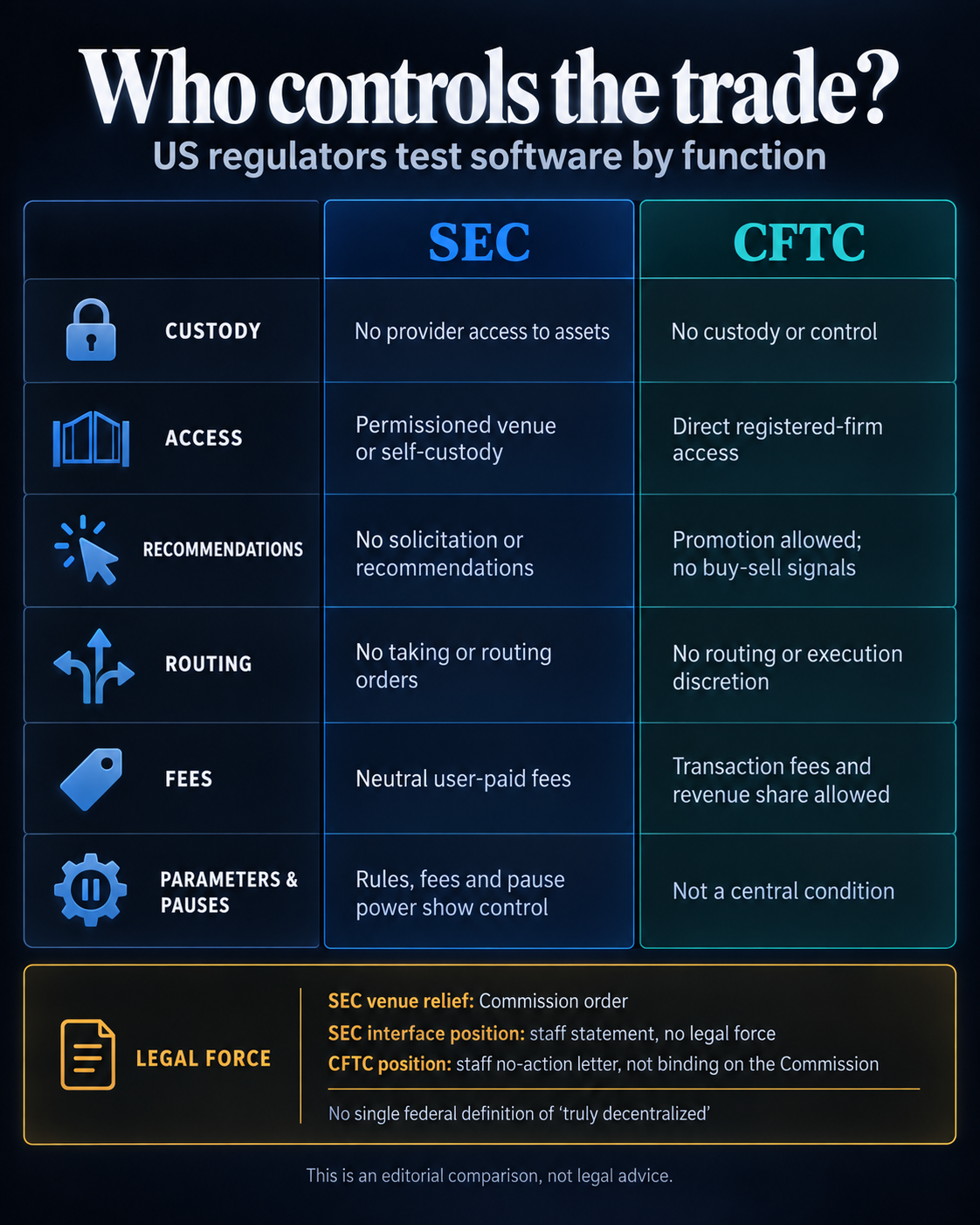
| Area of control | SEC order or staff position | CFTC staff position | Scope of the condition |
|---|---|---|---|
| Custody | The interface provider is barred from holding or accessing user assets | The provider is barred from custody or control of customer property | Each staff position requires separation from customer property |
| Access | A TSV sets participant standards; an interface discloses venue limits | Users trade on a DCM directly or through a member FCM or IB and retain direct access to the registrant | Each document specifies its own access structure |
| Recommendations | The interface position excludes specific-transaction solicitation and investment recommendations | Promotion may be allowed; explicit buy or sell signals are excluded | The staff positions draw different lines around steering |
| Routing | The interface provider is barred from taking or routing orders; displayed alternatives use objective parameters | User-directed transmission may occur; provider discretion over routing or execution is barred | The SEC position excludes order routing, while the CFTC position centers on discretion |
| Fees | User-paid charges must be objectively determined and neutral | Transaction fees and registrant revenue sharing may be allowed | Compensation is treated within each statutory setting |
| Parameters and pauses | Changing pool rules, parameters or fees, or pausing trading can mean a person provides the pool | The letter gives these powers no central role | The SEC factor belongs to the order’s specific venue exemption |
Every factor operates inside its source document’s narrow scope. The Commission order governs one securities-venue model. SEC staff states its Section 15 position for covered interfaces. CFTC staff offers conditional enforcement forbearance within the registered derivatives market.
Technical design matters alongside disclosures, access arrangements, marketing limits, recordkeeping and retained authority. The relevant mix changes across securities venues, crypto interfaces and derivatives software.
Who decides what counts as “truly decentralized”
Peirce supplies a principle: Removing the trusted intermediary weakens the regulatory rationale built around that intermediary. Her individual statement carries no power to establish a Commission category.
Authority is divided across the actions described here. The Commission defines the scope of its TSV order. The SEC’s Division of Trading and Markets applies its own nonbinding Section 15 position. The CFTC’s Market Participants Division decides whether presented facts fit its conditional enforcement posture. Each judgment answers a question arising under a particular statute and form of relief.
A protocol, its governance process and its frontend may occupy different points on the control spectrum. The core protocol may be difficult to alter while an interface remains curated, fee-taking and capable of steering users. Software may also connect users to regulated firms while leaving orders, assets and execution outside the provider’s discretion.
For builders and users, the practical inquiry begins with specific powers: Who controls access and assets? Who can recommend, route or execute a transaction? Who sets fees or changes software parameters? Who can pause the system? The governing statute and the actor exercising those powers then determine which regulator and legal standard apply.
“Truly decentralized” remains Peirce’s description. Federal law provides no matching legal category. These SEC and CFTC actions produce a fact-specific map of retained authority, with separate boundaries for the Commission order and each staff position.
