

A Kraken-distributed USDC vault will direct part of its yield to XRP-linked collateral providers underwriting DeFi losses.
On Oct. 15, Firelight announced the addition of Kraken’s Protected Strategies USDC vault, extending a coverage protocol launched earlier this month to an investment product available through the exchange’s DeFi Earn service. Sentora, the vault’s independent curator, arranged the enrollment.
The deal creates a potential source of recurring income for holders willing to deploy XRP-linked capital on Flare. Fees from the vault’s returns flow to Firelight, where collateral providers share in premiums in exchange for accepting losses from eligible exploits and protocol failures.
For Kraken’s depositors, the protection comes at the cost of a lower investment yield. Its published annual percentage yield already accounts for coverage fees set by Firelight and Sentora, which can change monthly. Kraken said it receives none of those fees and neither arranges nor guarantees the payouts.
The integration gives Firelight access to a new distribution channel as demand for ways to reduce decentralized finance risk becomes a potential business for holders of cryptocurrency capital.
Kraken vault turns protection fees into XRP-linked income
Firelight operates on Flare, where participants supply FXRP, a representation of XRP created through the network’s FAssets system. Stakers receive stXRP, which tracks their claim on the pool backing Firelight’s coverage commitments.
When a vault operator pays for protection, Firelight channels the premiums into the shared capital pool. Firelight converts fees paid in USDC into FXRP, increasing the collateral backing each staker’s position. Returns compound through the redemption value of stXRP rather than through additional tokens distributed to their wallets.
The structure ties potential earnings to the amount of protection customers purchase and continue renewing. Firelight’s Oct. 6 launch initially covered Sentora’s USD Protected and Protected RWA vaults. The Kraken-distributed product adds another fee source to the same pool.
That distinction is significant for the XRP market. Kraken users entering the USDC vault do not need XRP, while collateral providers can use XRP they already hold to obtain FXRP. The integration could generate demand for FXRP through converted premiums, but its launch creates no particular amount of new native XRP purchases.
The service also offers a different source of returns from the token incentives common in DeFi. Firelight separately provides participation rewards and points, while its base staking earnings come from coverage fees. As more vault operators buy protection, recurring payments could expand independently of promotional incentives.
The protocol has not disclosed how much premium income the Kraken vault has generated or how much FXRP has been acquired from those fees. The size of the opportunity therefore depends on whether customers continue paying for protection and whether more capital is committed to back it.
XRP holders take on losses across the coverage pool
Those returns come with a direct obligation. Firelight’s staked capital supports all active covered vaults, meaning a provider earning premiums associated with Kraken can suffer losses from qualifying incidents elsewhere in the portfolio.
The protocol first pays validated claims from a stablecoin reserve called the First-Loss Buffer. If that reserve is exhausted, Firelight proportionally reduces the underlying assets backing each staker’s position, a process known as slashing.
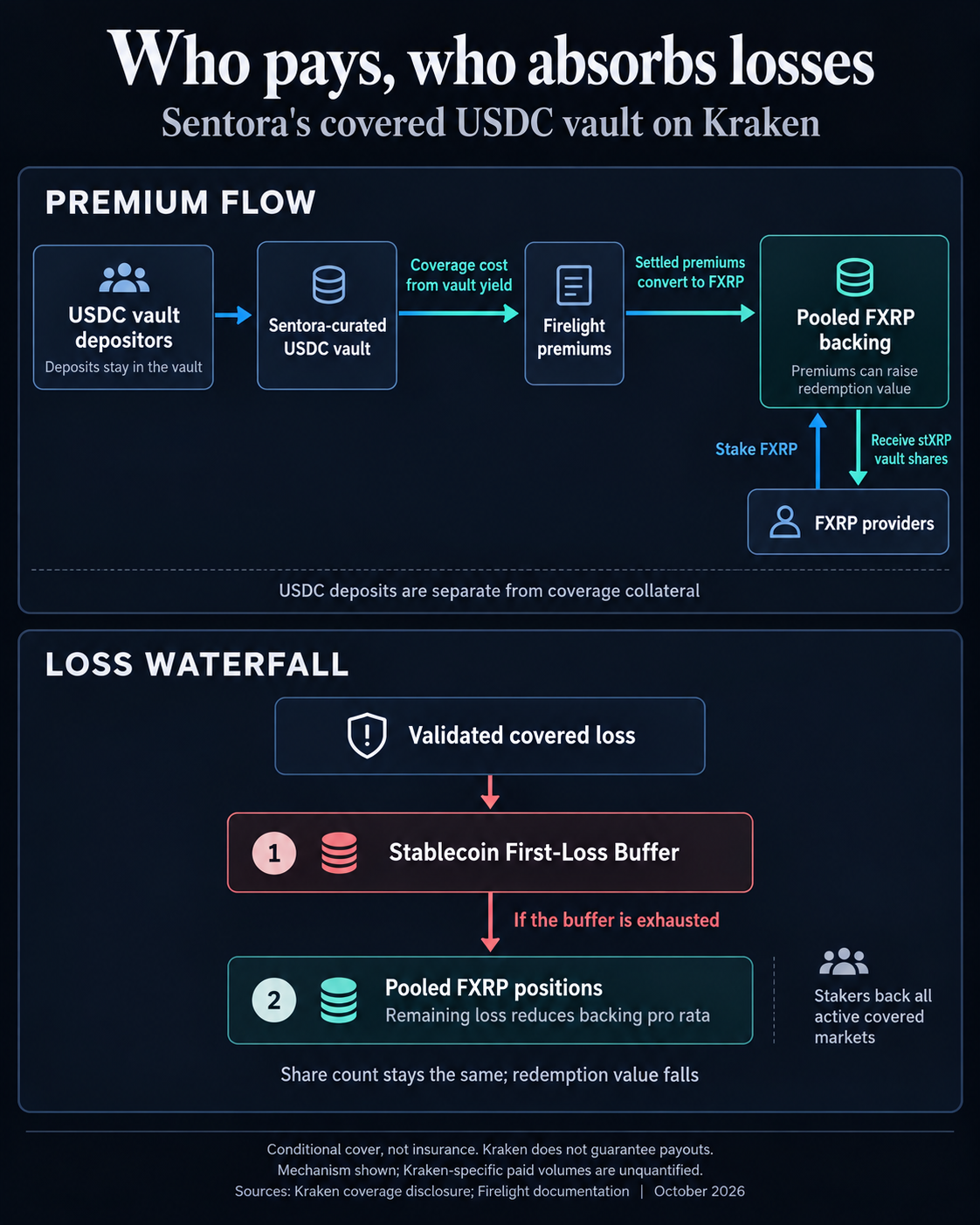
A successful claim can therefore reduce the amount of FXRP redeemable against a position. Premiums already compounded into the pool remain exposed alongside the original collateral.
Depositors in Kraken’s Protected Strategies USDC vault are eligible for compensation of up to $100,000 per address for each coverage period. Payments are also limited by the vault’s overall coverage limit and available capital, so an accepted claim does not necessarily mean full reimbursement.
Covered events include specified smart-contract exploits, oracle failures, governance attacks, and failures in protocols’ economic mechanisms. Ordinary asset-price declines, changes in advertised yield and routine liquidity shortages fall outside the arrangement.
Firelight’s independent Risk Consortium determines whether an incident qualifies, and Sentora distributes any resulting USDC payments to eligible wallets. Kraken does not finance those claims.
Capital providers also face constraints when trying to leave. Withdrawals currently take 30 to 60 days after an unstaking request, and exposure to eligible losses can continue during part of that waiting period even though premium accrual ends when the request is submitted.
Monthly renewals will test XRP yield demand
Firelight resets coverage terms, prices and capacity across 30-day periods. Each renewal gives vault operators another opportunity to weigh the cost against the value of protection, and it determines how much premium revenue can continue flowing to stakers.
The system’s capacity also depends on the dollar value of FXRP collateral and its stablecoin loss reserve. A decline in XRP’s price can reduce available backing even before a covered incident occurs, potentially constraining how much new protection Firelight can offer.
The commercial test will be visible in paid premiums, their conversion into FXRP, and the capital providers’ commitment after those fees and risks become clearer. Strong recurring demand could deepen the pool and support more covered products, while losses or withdrawals could limit its growth.
At the next coverage reset, Sentora and Firelight can revise fees and coverage limits, testing whether depositors continue paying for protection and XRP-linked investors remain willing to provide the capital backing it.
