


Michael Saylor has roughly one week to orchestrate STRC’s return to its $100 par value by his informal Sept. 8 target, but the financial machinery required to close the final gap is running hot.
Despite deploying $635.2 million on aggressive buybacks, Strategy’s preferred security continues to hover around $97. The company has simultaneously restarted its Bitcoin accumulation after a two-month freeze, signaling confidence that its balance sheet can absorb both demands.
Yet, the path to par has morphed into a highly capital-intensive grind just as a wave of competing Bitcoin-linked yield products hits the market.
The coming days will test more than Saylor’s 70-trading-day timeline, a target calculated from STRC’s latest recovery starting May 28. It will reveal how much more capital the firm is willing to deploy before relying on organic institutional demand to anchor the security.
The final $3 is costing Strategy more
The economics of the buyback campaign have deteriorated steadily as STRC climbs toward par, upending the company’s initial strategy.
When Strategy began repurchasing STRC in July, management outlined a clear tapering framework: deploy more capital at deeper discounts to capture attractive economics, then scale back as the security approached $100, where independent investor demand would theoretically take the reins.
Instead, weekly spending has accelerated as the discount narrowed.
| Repurchase Period | Capital Deployed | Average Price | Discount to $100 Par |
|---|---|---|---|
| July 20–26 | $25.0 million | $86.52 | 13.48% |
| July 27–Aug. 2 | $81.2 million | $89.02 | 10.98% |
| Aug. 3–9 | $108.6 million | $94.27 | 5.73% |
| Aug. 10–16 | $132.2 million | $95.20 | 4.80% |
| Aug. 17–23 | $136.4 million | $95.30 | 4.70% |
| Aug. 24–30 | $151.8 million | $97.48 | 2.52% |
| Total | $635.2 million | — | — |
Buying below par still carries a basic economic rationale. Every share retired for less than $100 eliminates $100 of stated value, along with its annualized 12% dividend obligation. However, the rapidly shrinking spread alters the campaign’s trade-off.
The firm now has just $364.8 million remaining under its $1 billion authorization. At the recent pace of spending, that runway could narrow quickly, leaving Strategy to decide how much more capital it is prepared to commit to support the final move to par.
MSTR and Bitcoin are carrying the STRC repair
Strategy has leaned heavily on its two largest sources of financial firepower, MSTR common stock and its Bitcoin holdings, to finance the STRC repair effort.
Between late June and early August, the firm sold a net 6,916 Bitcoin across four disclosed transactions to fund preferred-stock obligations and, in later transactions, STRC repurchases.
Last week, Strategy pivoted back toward common-equity issuance, selling 4.53 million MSTR shares for $602.8 million in net proceeds. Of that amount, $151.8 million funded the latest STRC repurchase while another $50.7 million covered STRC dividends.
The company also deployed $369.7 million to acquire 4,603 Bitcoin, its first purchase in roughly two months, pushing its total stockpile to 845,050 BTC. Another $30 million went into its flexible cash pool.
To fortify the structure surrounding its preferred securities, Strategy has ring-fenced a $5.1 billion USD Reserve earmarked for preferred dividends and debt interest, backed by a separate roughly $1.6 billion pool of flexible USD Cash.
It has also maintained STRC’s annualized dividend at 12% and instituted a policy barring new STRC issuance below $100.
Those moves temporarily invert the security’s intended design.
STRC was engineered to raise capital from investors that Strategy could deploy across its balance sheet, including toward Bitcoin purchases. Instead, the company spent much of the summer using proceeds from MSTR issuance and, at times, Bitcoin sales to service and repurchase STRC.
The return to Bitcoin buying suggests Strategy believes the rebuilt mechanics around the preferred are now strong enough to support both sides of the strategy simultaneously.
STRC’s real test begins at $100
The ultimate gauge of success arrives when Strategy reduces its own purchases and asks outside investors to carry STRC around $100.
Traditional finance has already demonstrated substantial appetite for the security. The initial July 2025 offering was originally slated for 5 million shares, or $500 million at stated value. Strong demand allowed the firm to increase the deal to more than 28 million shares and raise $2.52 billion.
By July 2026, Saylor said Digital Credit was entering the institutional mainstream, pointing to $756 million of STRC held across three major US preferred-stock ETFs: BlackRock’s PFF, Virtus InfraCap’s PFFA and VanEck’s PFXF. STRC was the largest individual holding in all three at the time.
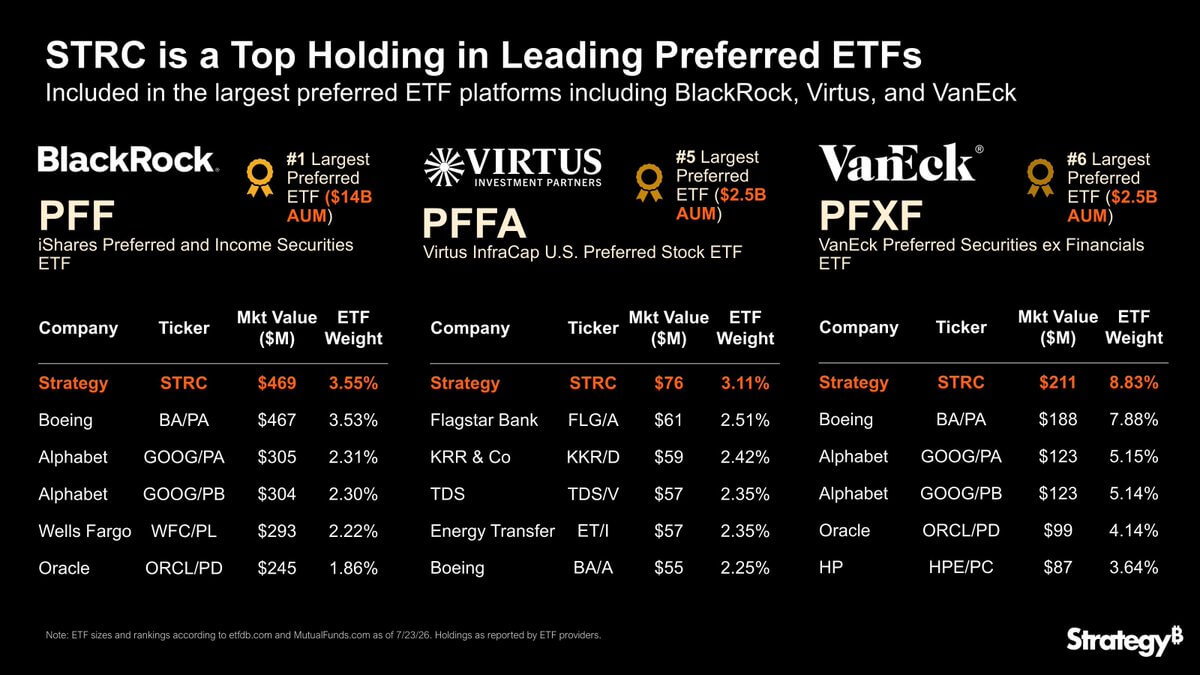
However, as STRC approaches $100, the market it is returning to is becoming more crowded.
Strive has expanded its SATA preferred stock, which carries a 13% annual dividend rate, pays distributions every business day, and follows a similar policy against issuing below $100.
Metaplanet is also building a broader Bitcoin-credit distribution platform. The Japanese Bitcoin treasury company acquired licensed securities platform Siiibo Securities to develop and distribute Bitcoin-linked yield products, while separately expanding its US presence through Super League Enterprise.
Those developments give investors seeking Bitcoin-linked income a growing menu of securities with different yields, payment schedules, and capital structures.
STRC enters that competition with an important advantage: scale and demonstrated institutional adoption. But reaching $100 will test whether that established investor base remains strong enough to replace Strategy’s own purchases and eventually absorb fresh issuance at par.
If outside demand does so as Strategy reduces buybacks, STRC can return to its intended role as a funding source for Bitcoin purchases.
However, if demand weakens as issuer support fades and competing products attract capital, reaching $100 may prove easier than sustaining it.
