


Bitcoin fell below $77,000 as softer US labor data failed to dislodge expectations for another Federal Reserve rate increase.
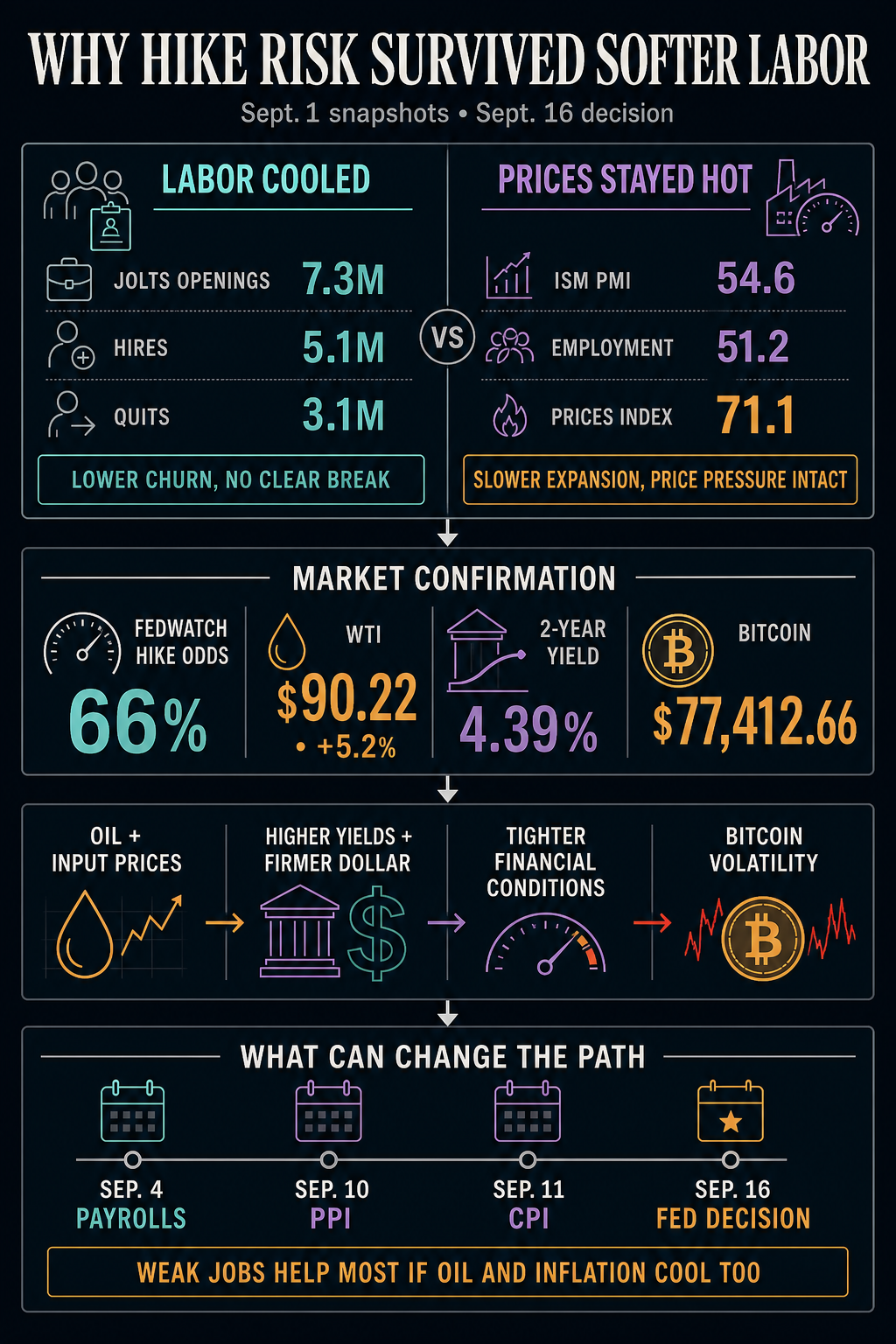
Data from CryptoSlate shows the largest cryptocurrency traded around $76,985 as of press time after July job openings held at 7.3 million and hiring remained subdued.
The release landed into a market already confronting $90 oil, rising Treasury yields and a Fed that has shifted sharply from discussing rate cuts to considering another hike.
Data from CME FedWatch showed the probability of a September rate increase at 66%, up from about 60% following Fed Chair Kevin Warsh’s Aug. 28 Jackson Hole speech.
JOLTS did not make markets more hawkish. Instead, the report failed to overturn an inflation-driven repricing already reinforced by higher energy prices and Treasury yields.
The Bureau of Labor Statistics reported 5.1 million hires and 3.1 million quits in July, with both measures little changed from the previous month. June openings were revised down by 177,000 to 7.2 million, while earlier estimates for hires and quits were also lowered.
The softer turnover arrived less than three weeks before the Fed’s Sept. 15-16 meeting, giving policymakers further evidence that the labor market is cooling without showing the type of contraction that would settle the policy debate.
Warsh had already drawn that distinction at Jackson Hole. He said employment remained consistent with full employment and argued that unusually low turnover partly reflected the wave of worker and employer rematching that followed the pandemic.
His concern instead remained inflation.
$90 oil keeps the hike trade alive
The inflation side of the debate strengthened elsewhere in Tuesday’s data.
The ISM manufacturing index eased to 54.6 in August from 55.6, while new orders fell to 53.7 from 56.7 and employment declined to 51.2 from 52.8.
But prices barely moved.
ISM’s Prices Index held at 71.1 for a second month, while respondents cited fuel and oil-based products among commodities becoming more expensive.
Crude then amplified the pressure. West Texas Intermediate surged 5.2% to settle at $90.22, while Brent gained 4.6% to $94.65 as the Iran crisis continued to unsettle energy markets.
Treasury yields moved higher alongside oil. The two-year yield rose to 4.39% from 4.34%, while the benchmark 10-year climbed to 4.79% from 4.75%.
The combination helps explain why weaker labor turnover failed to knock down September hike expectations. The Fed entered 2026 expecting several rate cuts, but markets are now assigning a better-than-even probability to another increase.
That reversal leaves Bitcoin facing a considerably less forgiving backdrop than investors anticipated earlier in the year.
Higher Treasury yields increase the return available on dollar assets and raise the hurdle for holding assets without contractual yield. A stronger dollar can also tighten financial conditions across speculative markets.
The latest ETF flows suggest some of that pressure is reaching crypto portfolios.
US spot Bitcoin ETFs recorded $236.46 million of net outflows on Sept. 1, reversing $216.7 million of inflows on Aug. 31. The one-day swing removed a source of institutional support just as Bitcoin slipped back below $77,000.
The reversal followed a volatile stretch for the asset. Bitcoin traded above $81,000 before Warsh’s Jackson Hole remarks pushed rate expectations higher and sent the cryptocurrency below $77,000. Its subsequent rebound has struggled to regain momentum as the September policy outlook hardened.
The Fed’s oil problem cuts both ways
The crude rally complicates the outlook because the same shock strengthening the inflation case can also weaken the economy.
James E. Thorne, chief market strategist at Wellington Altus, argued that raising rates in response to an externally driven energy shock could compound the economic damage.
Higher crude prices raise transport and production costs, reduce household purchasing power, and squeeze corporate margins. Consumers spending more on fuel have less available for other purchases, while companies facing higher input costs can respond by cutting investment or hiring.
The Fed can weaken domestic demand through higher borrowing costs, Thorne said, but it cannot increase oil supply or resolve the geopolitical conditions pushing crude higher.
That distinction becomes more important if the labor market deteriorates further.
July JOLTS has already shown weaker turnover, while the latest ISM employment reading cooled. Neither has yet produced the kind of break that would clearly override Warsh’s inflation concerns.
The next employment report could change that balance.
August payroll data arrives Sept. 4, followed by producer prices on Sept. 10 and consumer prices on Sept. 11. The Fed announces its decision Sept. 16.
A materially weak payroll report would challenge the view that employment remains consistent with full employment. If oil also retreats and subsequent inflation data soften, markets would have a clearer reason to unwind September hike expectations and push yields lower.
Weak employment alongside crude near current levels would create a harder problem. Labor conditions would be deteriorating while an external supply shock kept inflation pressure elevated.
Firm hiring alongside persistent price pressure would reinforce the current setup and could push short-term yields higher again.
Bitcoin enters that sequence back near the level reached during the initial post-Jackson Hole selloff, and without the ETF support it carried into the week.
