
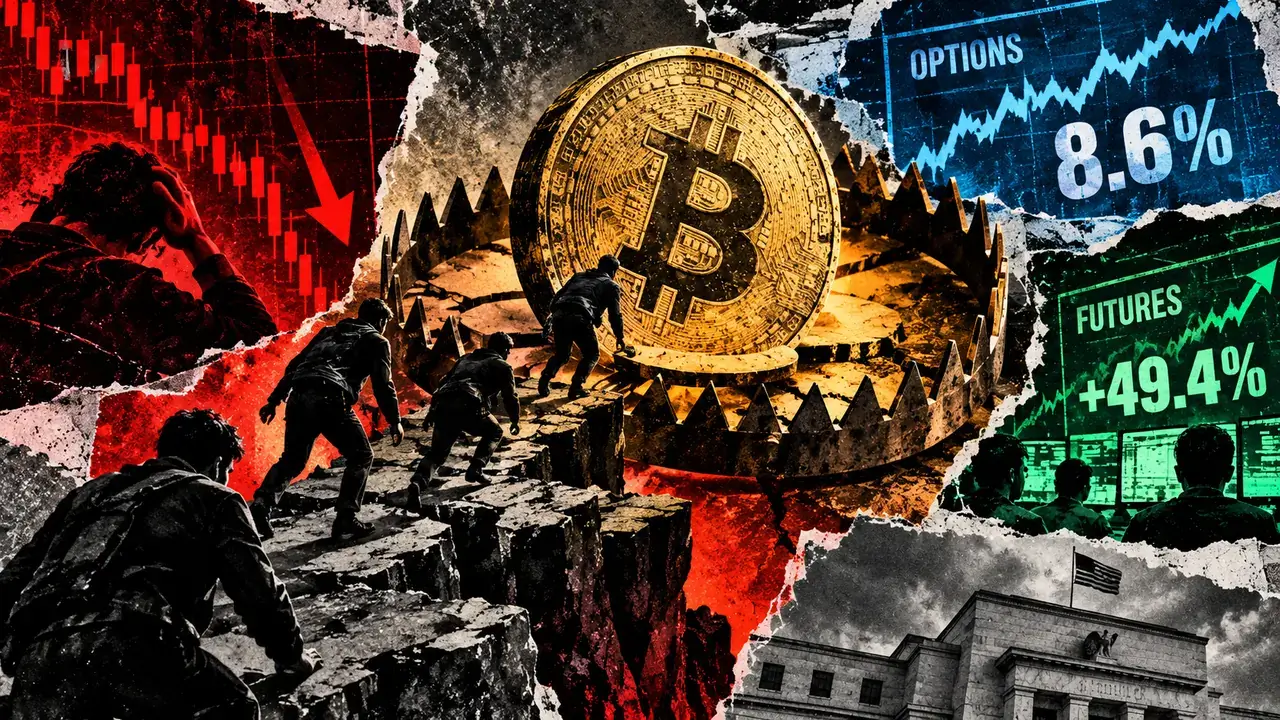
Bitcoin options traders are becoming more defensive even as leveraged futures traders maintain bullish exposure amid persistent spot selling.
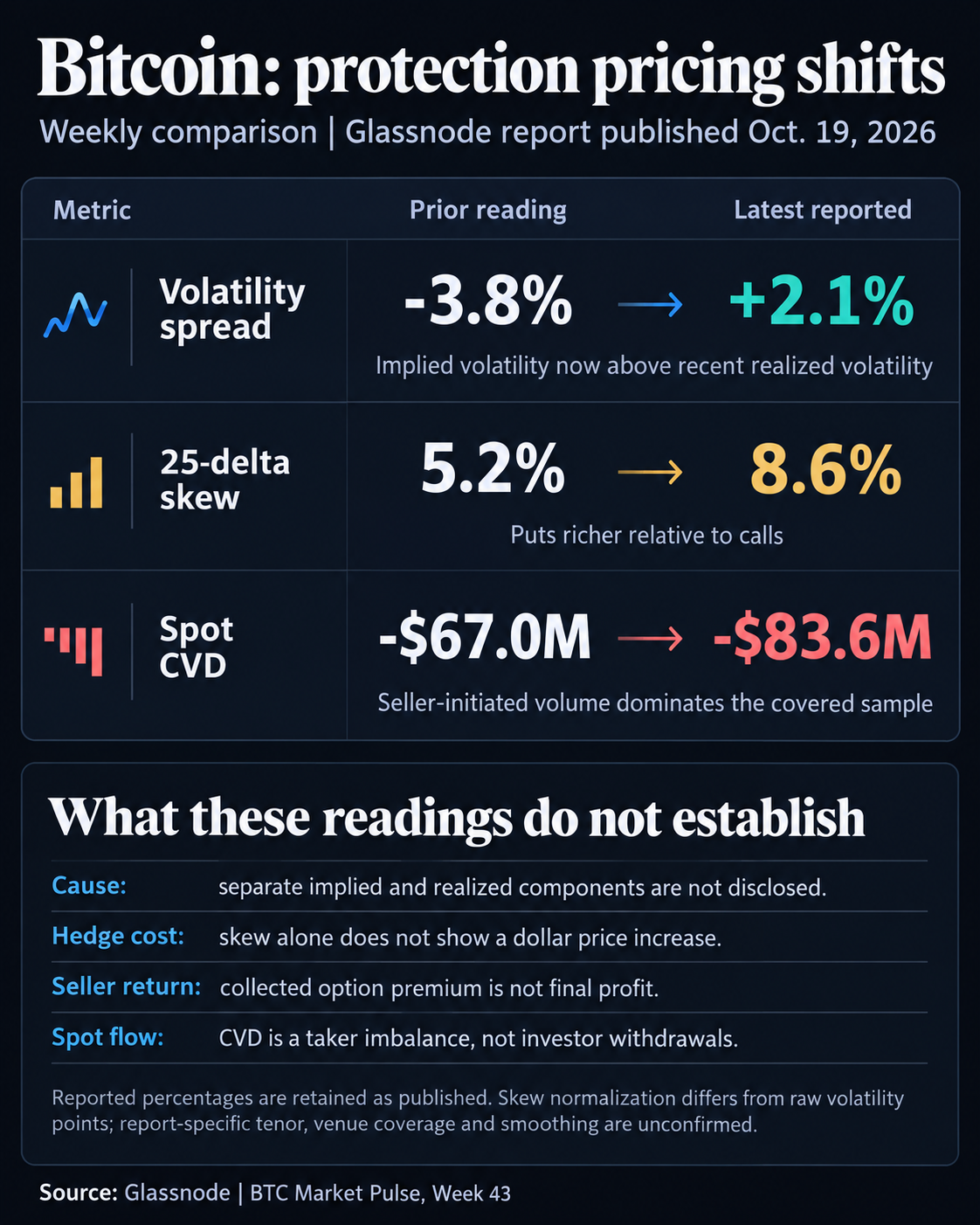
An Oct. 19 Glassnode report showed Bitcoin’s 25-delta options skew climbing from 5.2% to 8.6% over the preceding week, reflecting a growing premium for downside protection relative to bullish options.
Meanwhile, aggregate funding payments by perpetual futures longs jumped 49.4% to $1.6 million, suggesting continued demand for leveraged bullish exposure despite weak buying activity in the underlying market.
The contrasting positions emerged as Bitcoin struggled to recover from October’s selloff. The cryptocurrency traded near $81,300 at press time, more than 2% lower than the previous week.
The divergence leaves Bitcoin exposed to renewed volatility if spot selling persists and leveraged traders are forced to reduce positions, particularly as investors prepare for another Federal Reserve interest-rate decision later this month.
Bitcoin options signal growing caution despite subdued price swings
Glassnode’s options data show investors are placing greater value on protection against further losses even as Bitcoin’s recent price movements have become relatively subdued.
The firm’s implied-versus-realized volatility spread shifted from -3.8% to +2.1 % over the week, indicating that volatility embedded in options prices moved above the cryptocurrency’s recent realized volatility.
The change reflects a market increasingly willing to pay a premium for exposure to potential future price swings after a period of comparatively restrained trading activity.
At the same time, Bitcoin’s 25-delta skew rose 3.4 percentage points, showing bearish put options became more expensive relative to comparable bullish calls.
That shift suggests investors are placing greater emphasis on protecting existing positions against further declines, particularly after Bitcoin’s failure to establish a sustained recovery above its late-September breakout levels.
However, the skew reading remains below the upper end of its historical statistical range. The market has become more defensive without reaching the extreme pricing typically associated with unusually elevated demand for downside protection.
Investors have also maintained substantial exposure to the options market.
Glassnode reported that Bitcoin options open interest rose 3.1% to $38.6 billion from $37.4 billion the prior week, suggesting outstanding derivative positions continued to expand despite weak spot market momentum.
Rising open interest, a stronger put skew, and a positive volatility spread point to a market where traders are maintaining exposure while placing greater value on protection against adverse price movements.
That defensive positioning has developed alongside continued deterioration in spot trading conditions.
Glassnode’s spot cumulative volume delta, which measures the imbalance between aggressive buying and selling, widened from -$67 million to -$83.6 million over the week.
The 24.7% deterioration indicates that sell orders increasingly outweighed aggressive purchases on the metric’s covered centralized exchanges, leaving Bitcoin without convincing evidence of sustained spot accumulation.
Trading volume nevertheless increased modestly from $5.4 billion to $5.5 billion, suggesting that participation remained relatively stable even as selling pressure intensified.
Futures traders retain bullish exposure as spot demand weakens
The continued weakness in spot trading contrasts with signs of renewed demand for leveraged bullish positions in Bitcoin’s perpetual futures market.
According to Glassnode, long-side funding payments rose from $1.1 million to $1.6 million over the week, returning to their normal statistical range after the earlier selloff weakened demand for bullish leverage.
Funding payments are exchanged between long and short traders to keep perpetual futures prices aligned with the underlying asset. The rise in aggregate payments suggests traders holding long positions collectively paid more to maintain their exposure.
Yet the recovery occurred without a corresponding expansion in outstanding futures contracts.
Bitcoin futures open interest slipped 0.3% to $36.4 billion from $36.5 billion, remaining near the upper end of its historical range.
That combination suggests leveraged exposure remains substantial, with bullish traders still incurring funding costs even as the broader market struggles to attract stronger spot buying.
There are also indications that futures selling pressure has eased.
Glassnode reported that perpetual futures cumulative volume delta improved from -$891.1 million to -$562.7 million, a 36.9% recovery that suggests aggressive selling moderated considerably during the week.
Nevertheless, the measure remained below its lower statistical band, showing that sell orders continued to dominate futures trading despite the improvement.
This creates an uneven market structure. Selling pressure has moderated among futures traders, but spot sellers remain active, while options investors are increasing the premium attached to downside protection.
On-chain positioning adds another potential source of sensitivity.
Glassnode found that the ratio of short-term to long-term holder supply increased from 14.5% to 14.7%, moving above its historical upper band. The share of capital held by newer, more price-sensitive investors also remained elevated at 20.3%.
The shift toward shorter-term ownership comes as profitability weakens. Bitcoin’s supply held in profit declined from 70.1% to 68.2%, while the realized profit-to-loss ratio fell from 0.8 to 0.4, indicating that realized losses were increasingly outweighing gains.
Those developments leave more price-sensitive capital exposed to a market where underlying buying demand has yet to recover convincingly.
The immediate test remains Bitcoin’s ability to defend $80,000, a level that has repeatedly attracted buying interest since the October decline.
Another breakdown could force leveraged longs to reduce exposure, intensifying selling pressure as options traders already pay a higher relative premium for downside protection.
The Federal Reserve’s Oct. 27–28 policy meeting adds another potential catalyst as investors assess whether persistent US inflation will require further monetary tightening.
