


US spot Bitcoin exchange-traded funds recorded about $635 million in net outflows Thursday as the cryptocurrency traded near the estimated cost basis of the funds’ Bitcoin holdings.
The Oct. 22 withdrawals were the largest daily outflow since June 25 and reversed nearly 60% of the inflows the funds attracted over the previous three trading sessions, per SoSoValue data.
BlackRock’s iShares Bitcoin Trust (IBIT) led the selling with $254 million in withdrawals, followed by Fidelity’s FBTC at $217 million. Together, the two funds accounted for approximately 74.2% of the day’s net outflows.
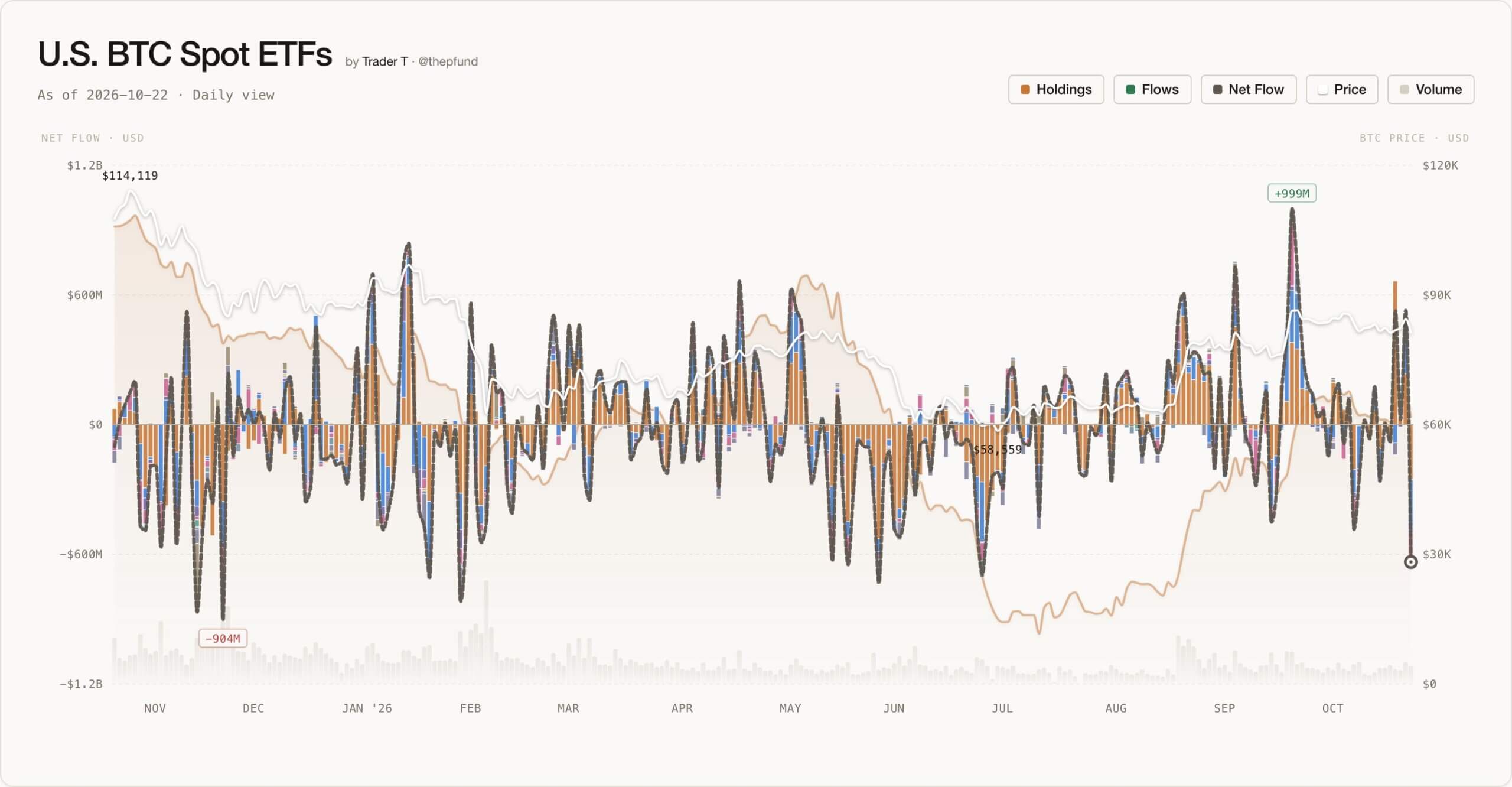
ARK Invest’s ARKB shed another $109 million, while Grayscale’s GBTC and Bitwise’s BITB lost $30 million and $27 million, respectively. Morgan Stanley’s MSBT was the only fund to attract fresh capital, recording about $2 million in inflows.
The reversal coincided with Bitcoin’s decline to as low as $80,841 during the reporting period, extending the cryptocurrency’s struggle to recover as escalating Middle East tensions and renewed concerns about US technology stocks unsettled financial markets.
Bitcoin’s institutional support faces pressure from rising oil prices
The latest withdrawals interrupted a recovery that had appeared to restore institutional demand following two consecutive weeks of ETF outflows.
Bitcoin funds attracted $527 million on Oct. 19, then $23 million on Oct. 20 and $528 million on Oct. 21. Thursday’s selling reduced the week’s net inflows to about $443 million.
Simon-Peter Massabni, head of business development at XS.com, told CryptoSlate that the unstable flows stem from increasingly cautious investors seeking short-term trading opportunities rather than committing capital for extended periods.
He said Bitcoin continues to find tentative support above $80,000, although buying momentum remains insufficient to establish a sustained recovery.
In its Oct. 21 market report, Glassnode estimated, using data through Oct. 19, that US spot Bitcoin ETFs acquired their holdings at an average price of approximately $81,500, while corporate Bitcoin treasuries hold their coins at an estimated average cost of $80,200.
The analytics firm found that buy orders around $80,000, substantially depleted during the Oct. 15 selloff, had been replenished by Oct. 20, although at smaller levels than previously recorded.
However, corporate treasury accumulation has weakened considerably, with monthly purchases remaining below one-tenth of their November 2024 peak since June. That has reduced another potential source of demand during market declines.
Glassnode identified the True Market Mean near $77,600 as the next major downside reference if Bitcoin closes below $80,000. Conversely, holders’ acquisition costs and concentrated selling orders between $85,000 and $87,500 could limit any recovery.
Massabni warned that developments beyond the cryptocurrency market could further constrain investors’ willingness to accumulate Bitcoin.
Escalating Middle East hostilities have raised concerns about energy supply disruptions, sending Brent crude above $110 a barrel and threatening to intensify global inflation pressures.
He argued that persistently elevated energy prices could force central banks to keep monetary policy restrictive, reducing liquidity available for speculative investments.
Pressure was also evident in US equities, with the Nasdaq Composite down 2.6% on Thursday and the S&P 500 down 1.21%, partly reflecting concerns about returns on heavy artificial intelligence infrastructure spending.
The Federal Reserve’s next policy decision is due Oct. 28.
Ethereum ETF withdrawals deepen
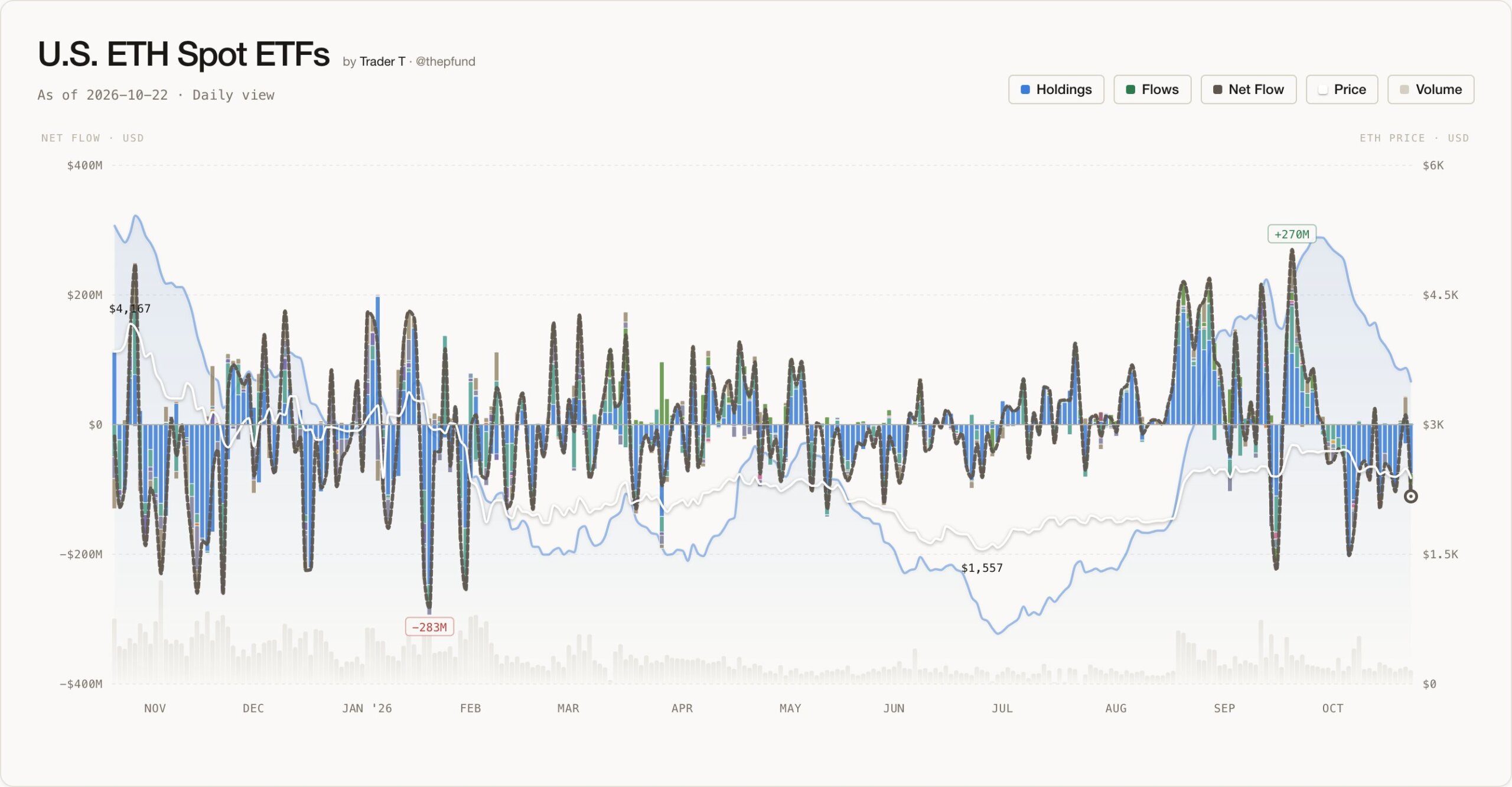
Ethereum has faced a more sustained withdrawal of ETF capital, with US-listed funds recording about $111 million in net outflows on Oct. 22.
SoSoValue ETF flow data show BlackRock’s ETHA lost $75 million, while its staking-focused ETHB product recorded another $17 million in withdrawals.
Grayscale’s two Ethereum funds shed a combined $20 million. Fidelity’s FETH attracted about $2 million, providing the only positive contribution among funds reporting activity.
The withdrawals brought Ethereum ETF losses to approximately $1,180 million in October, exceeding September’s $832 million in inflows and reducing year-to-date net inflows to about $387 million.
Massabni observed that institutional demand for Ethereum remains inconsistent despite occasional positive flow sessions.
The funds lost a combined $129 million across Oct. 19 and 20 before attracting $15 million on Oct. 21. Even during that brief recovery, BlackRock’s ETHA continued to experience withdrawals.
“One session of inflows is encouraging, but it is not enough to offset the preceding withdrawals,” Massabni said.
He added that Ethereum’s price recovery would require several consecutive sessions of sustained buying, with the cryptocurrency struggling to establish a firm base around $2,400.
