


A lawsuit seeking legal ownership of long-dormant Bitcoin addresses, including wallets tied by researchers to Bitcoin’s earliest mining era, has narrowed after the plaintiffs dropped 44 defendants that moved funds after the case was filed.
The July 7 voluntary discontinuance removes only a small slice of the 39,069 wallets targeted by the case. But the filing has sharpened scrutiny of the plaintiffs’ central claim that inactivity on a blockchain can support a court declaration that the assets have been abandoned.
The lawsuit, filed in New York County Supreme Court by ABC Company, XYZ Company and a pseudonymous plaintiff known as Noah Doe, asks the court to recognize the plaintiffs as owners of wallets they say were found, reported to police, and left unclaimed after a notice campaign.
The case has drawn attention because the addresses collectively hold millions of Bitcoin, including coins from the network’s earliest years and those associated with Satoshi Nakamoto, Bitcoin’s pseudonymous creator.
While the latest filing does not explain why the 44 respondents were removed, blockchain researchers tracking the case say every one of those addresses had moved coins after the lawsuit began.
Those addresses held 21,443 BTC when the case was filed, Galaxy Digital’s head of research Alex Thorn said in a July 8 post reviewing the discontinuance. They later moved 46,334 BTC on-chain and now hold about 3,097 BTC, he said. At recent Bitcoin prices, the post-filing movement was worth roughly $2.9 billion.
Thorn said the largest removed address, listed as John Doe 106, held roughly 2,100 BTC at the start of the case and moved more than 20,000 BTC through the address across multiple transactions from March through July, while still holding nearly 2,000 BTC.
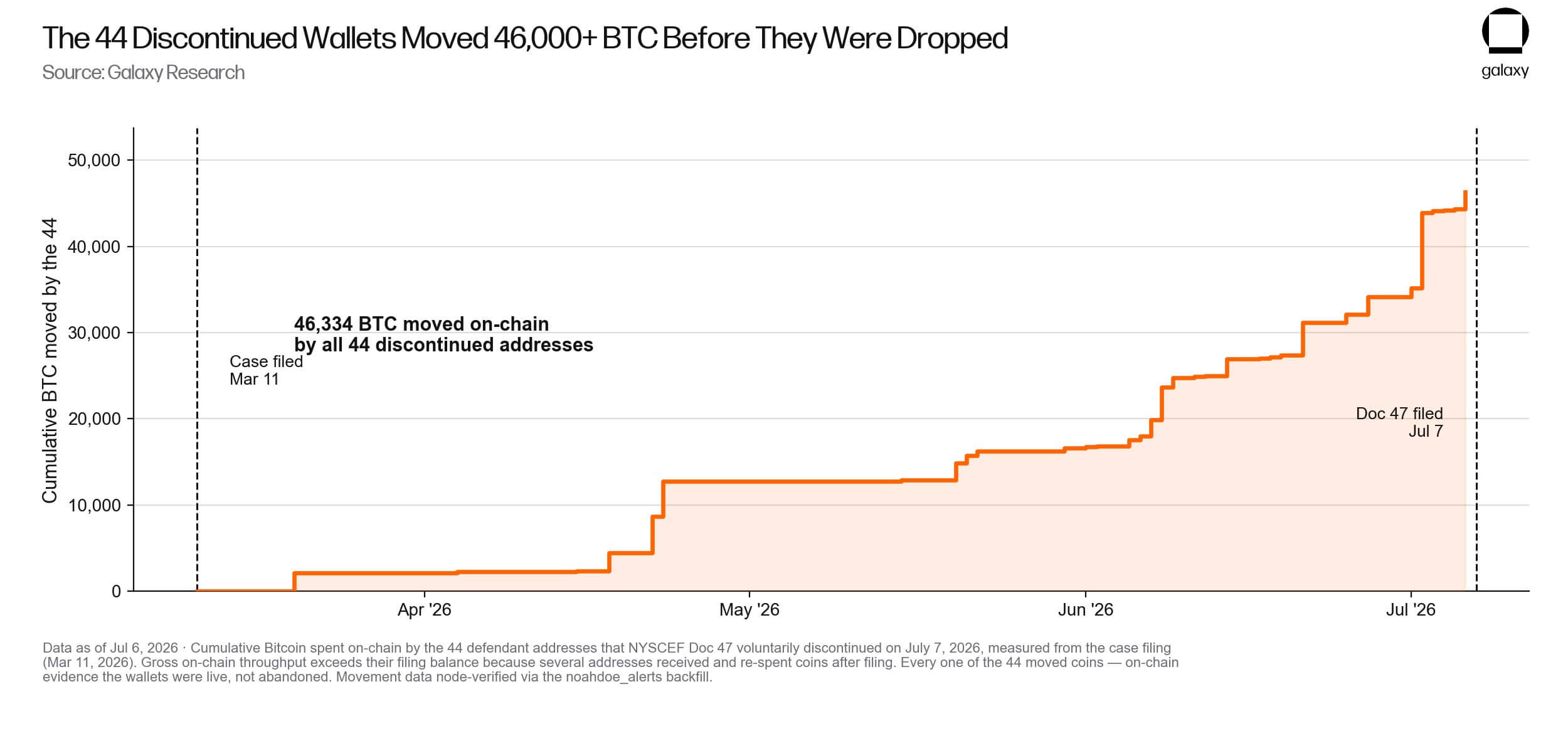
That on-chain activity cuts directly into the plaintiffs’ own framework. In their amended complaint, the plaintiffs said hundreds of addresses had already been removed from the broader pool because they took “on-chain” action showing Noah Doe that the wallets had not been abandoned.
The remaining 39,069 wallets, the complaint said, had taken no such action and were therefore abandoned.
The July 7 filing leaves 39,025 wallets in the case. But it also raises a narrower, more immediate question for the court: whether a wallet can be treated as abandoned until the moment it signs a transaction, and whether silence alone can carry the legal weight the plaintiffs place on it.
John Doe 33 raises the stakes
Apart from the BTC movement, the lawsuit also faces a direct challenge from a person claiming ownership rights over assets swept into the case.
John Doe 33, a pseudonymous defendant who says he is appearing as a natural person, filed a verified answer and affirmative defenses on July 8. His filing says he is not conceding jurisdiction and is not appearing as a wallet, address, ledger coordinate, or numbered entry in the plaintiffs’ exhibit.
According to the filing, John Doe 33 says his portfolio exceeded $80 billion when the plaintiffs filed the case.
John Doe 33’s filing attacks the lawsuit on several fronts. He argues that public Bitcoin addresses are not legal persons and cannot be sued as defendants.
He says the plaintiffs deposited USB drives containing public blockchain data with the NYPD, but that copying public address data onto a device does not mean the plaintiffs found the wallets or came into possession of the Bitcoin tied to them.
He also challenges the notice process. The plaintiffs relied, in part, on OP_RETURN messages, a Bitcoin feature that allows data to be embedded in a transaction.
However, John Doe 33 argues that this did not notify wallet owners because addresses are public identifiers, whereas wallets and private keys are private.
According to him, many wallet interfaces do not display OP_RETURN payloads, and cold-storage users may have no reason to monitor such messages.
His filing further alleges that plaintiffs’ counsel represented that reasonable efforts had been made to locate owners even though, he says, an identified owner had contacted counsel’s office by telephone.
That allegation, if credited, could heighten scrutiny over the plaintiffs’ claim that the owners were unknown, unreachable, and silent.
Amicus filings broaden the fight beyond Satoshi coins
The wallet movements and John Doe 33’s appearance have given new force to arguments already raised by outside parties.
Attorney Ian R. Cohen filed the first proposed amicus brief in late May, asking the court to consider whether New York’s lost-property framework applies to public blockchain addresses and whether inactivity can substitute for proof that an owner intended to abandon property.
The Digital Chamber, a blockchain trade association, filed a second proposed amicus brief on July 6. The group warned that accepting the plaintiffs’ theory would place a cloud over self-custodied digital assets and pressure holders to transact merely to prove continued ownership.
The group also argued that the plaintiffs never possessed the wallets and cannot access the Bitcoin without private keys. The amended complaint itself acknowledges that a private key is required to withdraw cryptocurrency.
That leaves the court with a practical question beyond title: whether a declaration of ownership would have any operational effect on coins that only the existing keyholder can move.
The Digital Chamber also raised concerns beyond crypto markets. If a court treats long inactivity as abandonment, holders of other tokenized assets or blockchain-based records could face uncertainty over whether quiet ownership remains protected when no public activity occurs.
That argument reaches beyond Satoshi-era coins. It goes to how courts understand digital property where control is proven through cryptographic signatures, not through possession of a physical object or an account at a named intermediary.
