


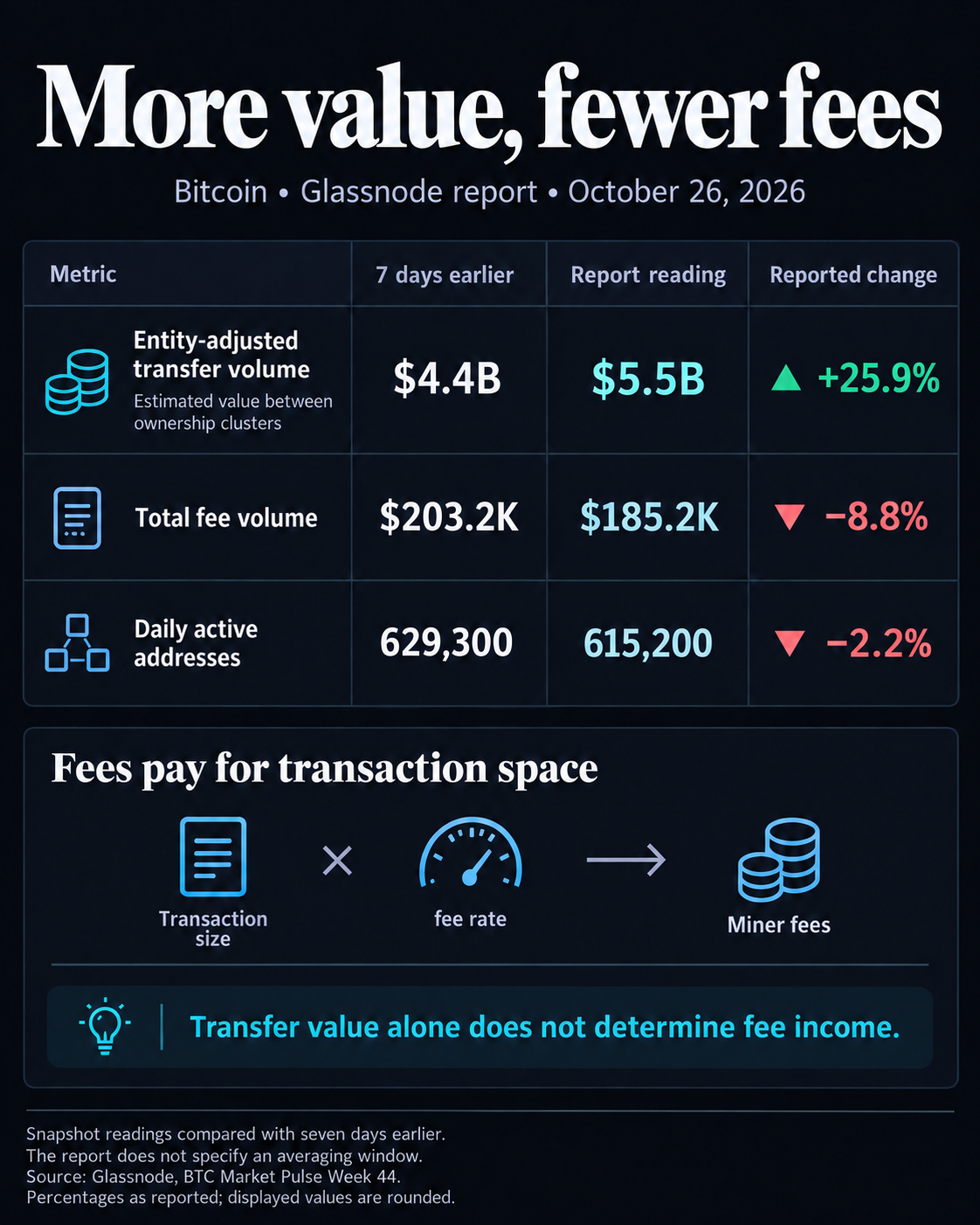
Bitcoin’s transfer value surged 26% to $5.5 billion last week, even as transaction fees paid to miners declined, according to Glassnode.
The blockchain analytics firm’s Oct. 26 report showed that entity-adjusted transfer volume climbed from $4.4 billion a week earlier, while total transaction fees fell 8.8% to $185,200 from $203,200.
Meanwhile, daily active addresses declined 2.2% to 615,200, highlighting a growing divergence between the amount of money moving across Bitcoin and the network activity generating revenue for miners.
Transaction fees account for less than 1% of Bitcoin miner revenue
Bitcoin miners typically earn revenue from two sources: newly issued BTC awarded for producing blocks and transaction fees paid by users competing for limited blockspace.
When network activity increases, users may offer higher fees to secure faster transaction confirmations, boosting miners’ earnings. However, fees depend on competition for blockspace rather than the dollar value transferred, meaning even large Bitcoin transactions can generate relatively little revenue.
This competition has remained subdued despite rising transfer volumes. Earlier this month, CryptoSlate reported that Bitcoin miners’ daily revenue climbed back above $40 million, with transaction fees accounting for less than 1% of their income.
Mining analysis platform Pool BTC illustrated the disparity using network activity from the 24 hours through Oct. 25, when miners produced 158 blocks and earned approximately 494 BTC in subsidies worth $39.5 million.
Transaction fees added just 1.88 BTC, worth roughly $150,000, equivalent to 0.38% of subsidy revenue.
The imbalance has persisted beyond a single reporting period. Pool BTC noted that fees accounted for just 0.69% of miner revenue on Aug. 11, citing Glassnode data, and have remained below 1% for much of the past year.
That dependence leaves miners heavily exposed to Bitcoin price fluctuations and the scheduled reduction in block rewards, which currently provide nearly all their income.
The next halving, expected in 2028, will reduce the subsidy from 3.125 BTC to 1.5625 BTC per block. Unless competition for blockspace strengthens enough to lift transaction fees, miners will need higher Bitcoin prices or lower operating costs to offset the reduction in newly issued coins.
