

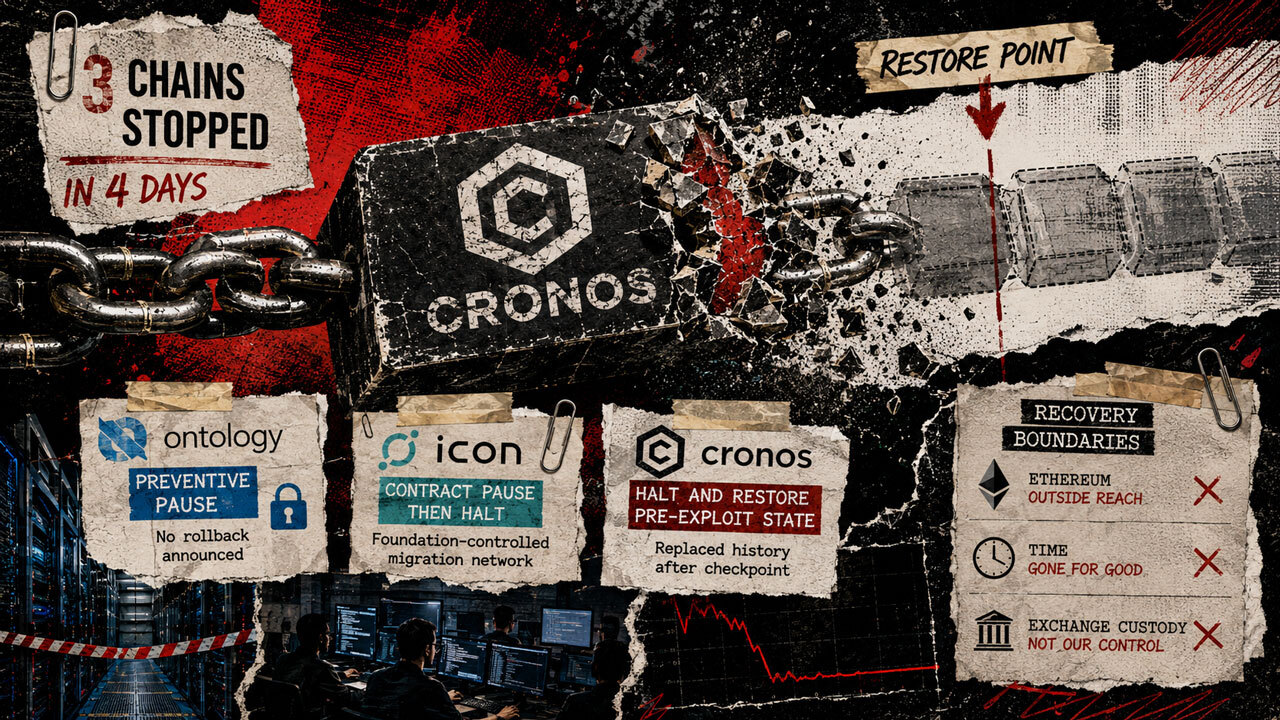
Three blockchain networks stopped producing blocks within four days. Each blockchain halt used different emergency powers, and Cronos alone also replaced part of its canonical history.
Cronos said validators halted the network by consensus after an exploit affected Tectonic, restored the chain to state from before the incident, and resumed production from block 90,896,189. The action replaced state as well as stopping production. Transactions and state changes that existed only after the chosen restore point no longer belonged to the restarted canonical chain.
Ontology and ICON used different emergency levers. Ontology suspended block production before confirming malicious attack activity, and its Sept. 1 update said that activity did not compromise user assets. ICON first paused an affected contract, then halted a network that the ICON Foundation said it controlled during a migration period, after most of the affected ICX had already entered exchange custody.
A blockchain halt reveals only the first layer of control. The deeper questions are who can order the stop, whether they can replace accepted state, and which losses remain when funds cross into another chain or a centralized custodian.
| Network | Trigger | Emergency action | Authority disclosed | Known recovery risk |
|---|---|---|---|---|
| Cronos | Tectonic exploit | Halt and restore pre-exploit state | Validator consensus; no tally or voting threshold in the restart notice | Discarded post-checkpoint activity; funds on Ethereum outside Cronos’s reach; final Tectonic accounting pending |
| Ontology | Potential concern found in a daily check; malicious activity later confirmed | Preventive block-production pause; no rollback announced | Core development team, technical team and validators; no emergency threshold disclosed | Transactions unavailable during remediation and a network upgrade; no user-asset compromise identified |
| ICON | Replay exploit in migration contracts | Contract pause, then network-wide halt | Foundation-controlled migration network operating with a reduced core validator set | Foundation-held loss; recovery of exchange-held ICX depends on custodians, legal process and law enforcement |
Cronos crossed the line from stopping to replacing state
Cronos described the incident response as a “validator-consensus emergency action.” Its Aug. 31 restart notice said block production resumed as of 23:49:01 UTC on Aug. 30 from block 90,896,189, using chain state restored to before the Tectonic exploit.
Cronos’s blockchain halt made the restore point an allocation decision. Exploit-related state after the checkpoint disappeared from the canonical chain, along with any unrelated transactions that existed only in the discarded history. The restart notice gives no transaction inventory, validator tally, voting-power threshold or list of participants. Cronos’s promised postmortem will need to explain both the procedure and the technical scope.
Even the amount protected by the intervention remains unsettled. TRM Labs estimated that roughly $75 million was borrowed after TONIC’s price was manipulated, with about $6 million reaching Ethereum and around $68.7 million reversed on Cronos. Bitquery reported a larger gross outflow, about $8.3 million on Ethereum and 10,961 discarded blocks.
Those figures measure different scopes; Tectonic’s final official loss remains pending. A narrower conclusion is already clear: a Cronos restore could reverse state still on Cronos, while Ethereum state remained outside its reach.
Tectonic’s recovery sequence leaves the user balance sheet unresolved. The protocol said it would reopen withdrawals and loan repayments first while keeping deposits and new borrowing paused. That creates an exit and deleveraging path, while suppliers’ ability to redeem in full remains unconfirmed. Tectonic’s pending postmortem still has to reconcile the exploit mechanism, gross outflow, bad debt, recovered assets and any residual liabilities.
Infrastructure also returns on a different schedule from consensus. Cronos warned that protocols, bridges, explorers and RPC providers would take longer to recover, while Alchemy’s status page separately recorded the halt and later resolution. A chain can declare a canonical restart before every service that depends on it is ready.
Ontology’s blockchain halt bought time rather than undoing transactions
Ontology’s action came before the network confirmed malicious activity. The network said its core development team found a potential security concern during a daily check and immediately suspended block production so its technical team and validators could review the system.
A Sept. 1 update said the review had identified malicious attack activity, that the mainnet would remain paused for remediation and an upgrade, and that the activity had not compromised user assets. Ontology aimed to restore normal operations within 24 hours, subject to successful security checks, remediation, upgrade work and testing.
Ontology’s blockchain halt left accepted state intact and stopped new settlement. Its announcement named no restore point or published set of transactions to invalidate.
The public description of authority remains incomplete. The announcement names the core development team, technical team and network validators, while leaving the binding decision-maker and numeric emergency threshold unidentified. Ontology’s VBFT documentation explains normal consensus mechanics, including how nodes generate and confirm blocks and how a management contract updates the consensus set. Those documents cover normal consensus mechanics; the emergency-pause rule used on Aug. 31 remains undisclosed.
The pause can still impose material costs without creating an asset deficit. Ontology told users that on-chain transactions would not be processed, advised against time-sensitive activity and later said resumption would follow remediation, a network upgrade and testing. Positions could not be adjusted on-chain, transfers could not settle, and connected services had to wait for the network’s next signal.
The resumption standard remains safety-based but is now more specific. Ontology said it aimed to restore normal operations within 24 hours if remediation, the network upgrade, testing and validation were completed successfully. The authority or threshold that would declare those conditions satisfied remains undisclosed.
The governance uncertainty is therefore specific. The network disclosed who was participating in the review, while the binding resumption authority remains unidentified. For users, the current exposure is operational delay rather than a confirmed user-asset loss or rollback.
ICON shows why a blockchain halt can arrive too late
ICON’s incident provides the clearest chronology of detection, containment and custody slipping apart.
According to the Foundation’s postmortem, an attacker replayed two previously valid signed withdrawal messages 1,492 times between 02:01:02 and 02:21:12 UTC on Aug. 27. A precision defect allowed 1,490 calls to succeed, releasing 119,866,000 ICX and 531,600 bnUSD from Foundation-held assets.
Monitoring alerted at 02:08 UTC. Technical staff began investigating later, and the affected contract was paused at 03:53. Exchanges began suspending ICX deposits and withdrawals at 05:54, while the network-wide halt took effect at 06:18:54. ICON restarted around 07:51 on Aug. 28, roughly 25 hours later, with a fix for the underlying defect.
The postmortem attributes the gap to incident response rather than missing detection. The first alert fired within seven minutes, but its severity did not page the on-call team because similar alerts had often accompanied unrelated RPC problems. Technical investigation opened around 03:40, shortly before the contract pause.
By the time the chain stopped, exchanges had already swept most of the affected ICX into their own custody. ICON-side controls could not stop an exchange from moving or converting assets it already held. The Foundation had to rely on exchange freezes, preservation notices, lawyers and law enforcement.
That custody boundary determined the loss allocation. ICON said all affected assets were Foundation-held and no user deposits, balances or positions were accessed. It reported 531,600 bnUSD and 1.366 million SODA recovered in full, plus 82,430 of 113,634 borrowed USDC recovered. Confirmed net loss stood at approximately 150.2 ETH plus 31,204 USDC, while most affected ICX remained frozen or traced at exchanges rather than recovered.
ICON’s control structure also differed from the other two cases. The postmortem said the Foundation controlled the network during token migration, and earlier migration guidance said consensus was operating in maintenance mode with seven core nodes. Its halt therefore came through a distinct, explicitly Foundation-controlled operating structure.
Emergency powers are also balance-sheet powers
Each blockchain halt moved risk to a different place.
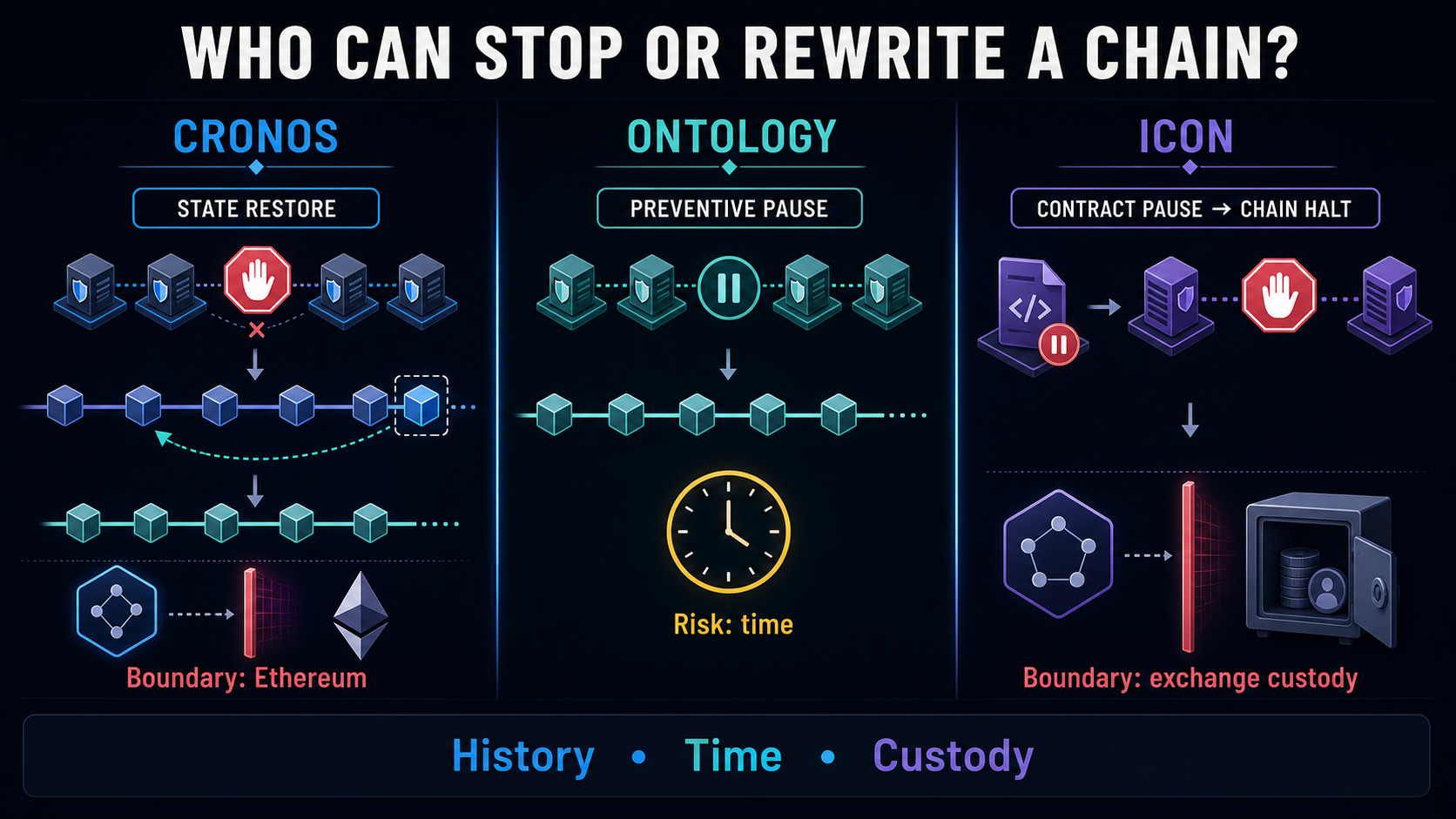
Cronos replaced canonical state. The restore could protect value still inside the chain’s jurisdiction, while invalidating activity beyond the exploit itself and leaving assets on Ethereum untouched.
Ontology shifted risk into time, availability and the inability to settle transactions while an undisclosed concern was investigated. Its notice reported no known balance-sheet loss.
ICON contained the vulnerable contract and then the chain after custody had moved. Its confirmed loss stayed with the Foundation, while recovery of frozen ICX became dependent on exchanges and legal authority.
A single decentralization score would blur those outcomes. The practical test is more specific: Is the emergency rule public? What threshold activates it? Does it stop new blocks or replace accepted state? Who owns assets outside the chain when the intervention arrives? Who has promised to absorb any remaining loss?
Cronos and Tectonic still owe answers in their postmortems. Ontology still has to disclose the attack details and emergency authorization, and later confirm whether its targeted upgrade and resumption criteria were met. The useful comparison is the boundary each network drew around whose history, time and money could be placed at risk.
