

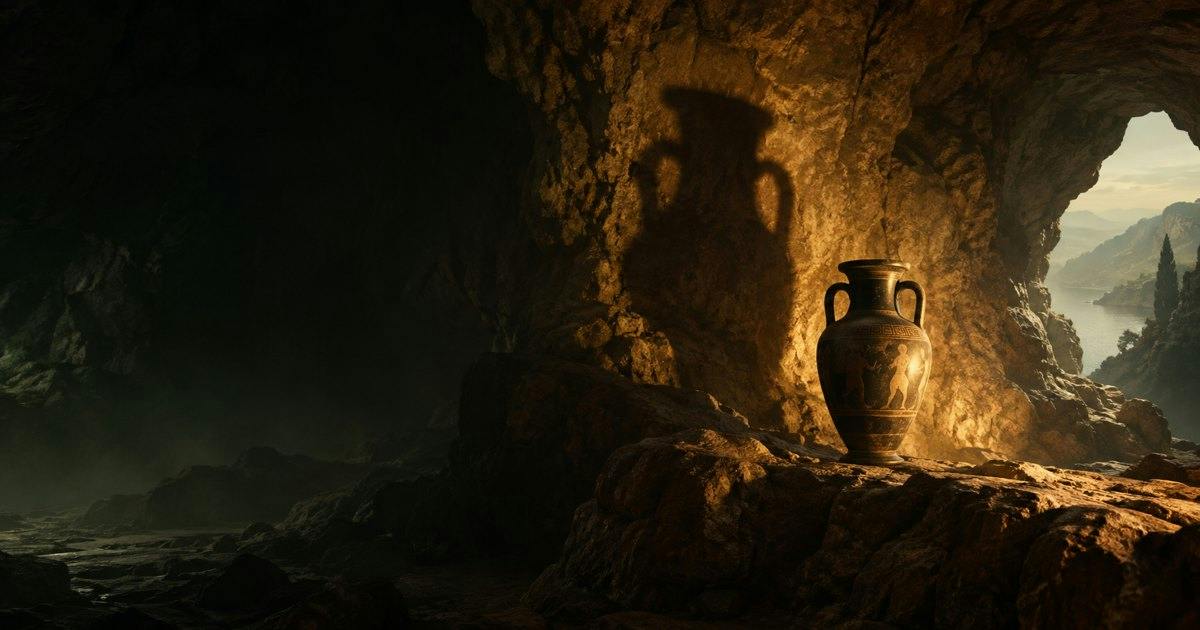
Disclosure: I am the artist behind Plato / The Unseen. This article was developed with AI assistance. The project’s collector mint is still being prepared; I do not present it as a proven commercial or behavioral success.
A loading screen asks us to wait because the system is busy. A story can ask us to wait because time is part of what it means. Designing an interactive artwork means deciding which kind of waiting the participant encounters, and making that difference understandable.
Plato / The Unseen explores that question through a browser-based NFT escape room on Base, inspired by Plato’s allegory of the cave. Five puzzle gates and a changing artwork lead to a real 24-hour pause before an optional, irreversible transformation into EIDOS. The structure raises a design question: can a collectible artwork make the passage of time part of the experience of owning it?
A pause needs a purpose
A countdown can create attention without creating meaning. If a participant sees only a locked button, they may reasonably understand the delay as a restriction imposed for the creator’s convenience. A narrative pause asks for more: a clear place in the journey, honest expectations about its duration, and an understandable relationship to what comes next.
In this work, the pause follows the fifth gate. It is a fixed part of the experience, rather than an advertised reward for repeatedly checking a feed. The artistic proposition is that the interval gives the participant space between solving a sequence and choosing an irreversible transformation. That is a proposition to examine, not a claim that a timer automatically produces reflection.
The distinction matters beyond blockchain art. A puzzle game, an online exhibition and a browser narrative can all use time. What makes the decision interesting is the relationship between the delay and the participant’s agency. If waiting has no role beyond withholding access, a story about contemplation will not make the restriction feel meaningful by itself.
Irreversibility changes the question
A reversible change lets someone experiment and return to an earlier state. An irreversible transformation carries a different burden of explanation. Participants should understand the consequence before making the choice. A poetic description cannot substitute for that information.
In Plato / The Unseen, the transformation into EIDOS is optional and irreversible. Those two properties belong together: completion of a sequence should not be described as an obligation to take the final step. Remaining with the earlier artwork can itself be a decision.
This also separates an interactive artwork from a checklist. A checklist assumes that the desired outcome is to finish every item. An artwork can leave room for a participant to consider whether the last available action is one they actually want to take.
The interface is part of the artwork
A visual world can suggest mystery while its interface remains precise. These are compatible goals. People can explore an ambiguous story while receiving clear information about a transaction, the duration of a wait, and the consequences of a transformation.
The experience runs in a browser and uses wallet transactions and gas on Base. These practical requirements deserve to be stated directly. Calling something an escape room does not remove the participant’s need to understand when a blockchain action is involved.
The same precision applies to promotional material. Our AI-assisted mood film introduces the visual world; it is not gameplay footage. It can communicate atmosphere, but it should not serve as evidence for interactions it does not show.
What remains to learn
The useful questions are about participation: do people understand where the pause belongs? Do they understand that the transformation is optional? Can they distinguish a narrative choice from a transaction they are being pressured to complete?
I do not yet have evidence that the work answers those questions successfully. Presenting the project as an experiment keeps those questions open. For an interactive collectible, the meaningful outcome may be less about reaching the final state than about making the choice to reach it intelligible.
Project reference: Plato / The Unseen
Author/project X:@PlatoUnseen
