


SUI Group Holdings has lent 6 million SUI tokens to Bluefin Markets under an uncollateralized agreement that lets the borrower reuse the assets and gives the Nasdaq-listed treasury company a share of Bluefin’s revenue. The arrangement may improve income, but SUI Group has not disclosed the revenue base needed to show that it can compensate for the added counterparty and liquidity risk.
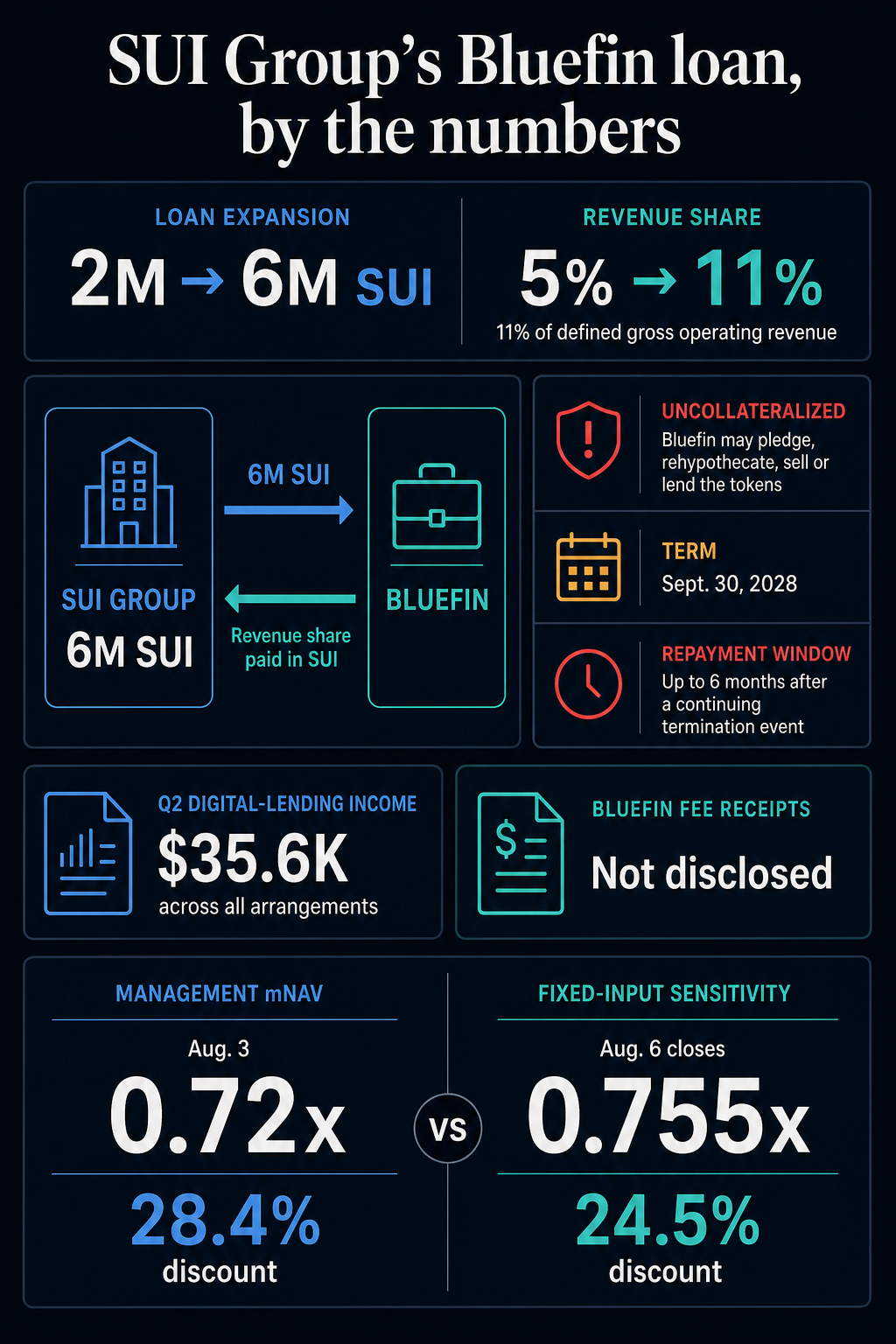
The company’s Aug. 6 results filing said it held 109.1 million SUI as of Aug. 3, including the 6 million SUI recorded as loan receivables. It marked the total position at $75.3 million using a $0.69 SUI reference price. Its management-defined, non-GAAP mNAV calculation put market capitalization at 0.72 times its company-calculated net asset value, implying a 28.4% discount.

How the revenue share works
A June 19 amendment increased Bluefin’s loan from 2 million to 6 million SUI and raised SUI Group’s fee from 5% to 11%. The agreement defines that fee as 11% of gross operating revenue across Bluefin and specified associated companies, including revenue tied to acquired Suilend assets. Payments are normally due twice monthly in SUI.
The 11% applies to qualifying revenue, leaving the return on the 6 million SUI dependent on Bluefin’s revenue base. SUI Group’s Form 10-Q reported $35,600 of digital-lending income across all arrangements in the second quarter, within $363,000 of total revenue. The amendment took effect late in the quarter, and the company did not identify Bluefin’s contribution, its qualifying revenue or post-amendment payments.

The prospective fee sits against a heavy loss base. Operating loss was $19.744 million and net loss was $18.907 million. Separately, SUI Group recorded $18.910 million of realized digital-asset losses, including $14 million tied to the additional Bluefin transfer. The company attributed the loss primarily to derecognizing SUI and recognizing a lower-valued receivable, describing that effect as noncash. The filing tied it to SUI price and derecognition accounting; it disclosed no principal shortfall or credit loss.
The loan also restricts access to the tokens. Bluefin may pledge, rehypothecate, sell or lend them, and the agreement runs through Sept. 30, 2028. Even after a continuing termination event makes repayment due, Bluefin has up to six months to return the SUI.

SUI Group’s 0.72 mNAV calculation used an Aug. 3 SUIG share price of $0.87 and a $0.69 SUI price, producing $70.38 million of market value against $98.36 million of company-calculated NAV. A static sensitivity that holds the adjusted share count and all non-SUI NAV inputs fixed and substitutes the Aug. 6 closes of $0.90 for SUIG and $0.672 for SUI produces roughly $72.81 million of market value against $96.40 million of NAV. That is about 0.755 times mNAV, or a 24.5% discount.
At fixed conversion values, the resulting $23.6 million gap is roughly equivalent to 11% of about $214.5 million in cumulative qualifying gross revenue.
The arithmetic offers a rough sense of scale, while any quarterly, annual, or breakeven estimate would need a clearer revenue base. Fee income would also lift NAV, and moves in SUIG or SUI could widen or narrow the gap, leaving Bluefin’s undisclosed revenue base as the key unknown.
Liquidity remains another constraint. At June 30, SUI Group had $7.53 million of current assets against $12.14 million of current liabilities, including $3.14 million of cash and cash equivalents.
The later $12.91 million cash-and-stablecoin figure was reconciled by starting with that June cash balance, which already included $1.7 million of USDC, subtracting $263,000 of subsequent cash movement, and adding $10.04 million of SuiUSDe.
The next test is whether SUI Group discloses qualifying Bluefin revenue and identifiable fee receipts. Those figures would show how much income the 11% share contributes while the company carries an uncollateralized receivable with long repayment terms.
