


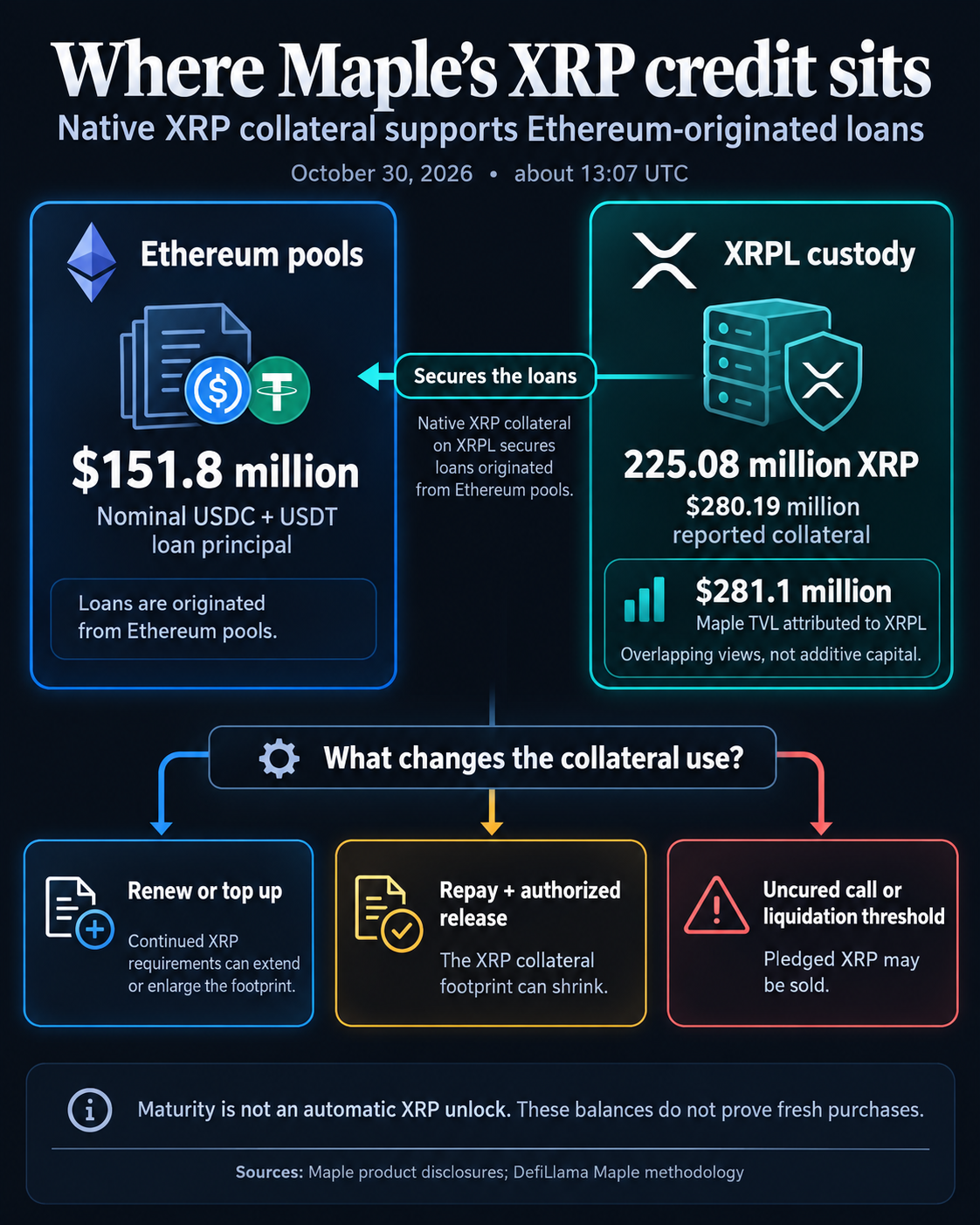
XRP Ledger’s reported DeFi value includes roughly $280 million in XRP collateral backing Maple loans funded from Ethereum pools, offering a reason to hold the token while borrowing stablecoins.
Yet the staying power depends on what happens to those loans. Maple reported about 225 million XRP across its syrupUSDC and syrupUSDT products, and three displayed XRP-backed positions carry approximately $151.8 million in nominal stablecoin principal, with maturities in December and January.
Borrowing against XRP can let an existing holder access liquidity while keeping exposure to the token. Renewals can extend that use, repayments can lead to authorized releases, and a failed margin call can lead to sales.
The credit behind XRPL’s collateral total
Maple’s syrupUSDC disclosure listed 142,766,086.05 XRP valued at $177.7 million, and its syrupUSDT disclosure listed 82,314,668.8 XRP valued at $102.5 million.
Together, the reported balances total about 225 million XRP and $280.2 million in displayed collateral.
| Product | Loan principal | XRP collateral value | Maturity |
|---|---|---|---|
| syrupUSDC | 41.6 million USDC | $74.2 million | Dec. 4, 2026 |
| syrupUSDC | 55 million USDC | $103.5 million | Dec. 12, 2026 |
| syrupUSDT | 55.2 million USDT | $102.5 million | Jan. 15, 2027 |
The combined principal is approximately $151.8 million at a nominal dollar per USDC or USDT. The two syrupUSDC loan collateral values are already included in that product’s XRP total.
Three positions also do not establish three distinct beneficial borrowers. Maple’s Borrower Hub supports multiple legal entities within one organization, so loan count alone cannot show how widely the exposure is distributed.
The public disclosures do not establish these positions’ exact collateral-release approvals or timing, so repayment would be key for the token holding demand, in conjunction with what collateral is released, retained, or pledged again.
DefiLlama showed Maple’s XRPL allocation at $281.1 million and total XRPL DeFi value at roughly $318 million in the same retrieval window. The key to interpreting that large contribution is where the collateral sits.
The Maple adapter says loans are issued from Ethereum pools while collateral is custodied on its native chain, crediting XRP to XRPL. This is native XRP supporting credit originated elsewhere, and is also specific to XRP-backed positions.
The adapter explicitly disables historical backfilling because its collateral metadata is current, so asking for an old block would return today’s collateral and rewrite the past with present holdings.
That limits the chart’s historical meaning: current holdings cannot establish when XRP was acquired or how much entered during a comparable earlier period.
How repayments and margin calls change XRP demand
The displayed collateral levels were 178.3% and 188.2% for the two USDC positions and 185.7% for the USDT position.
Maple’s undated, currently hosted default procedure says initial, margin-call, and liquidation loan-to-value levels are set for each loan at origination. A margin call starts a 12-to-24-hour timer and gives the borrower instructions to top up collateral or repay.
Posting additional XRP could increase the tokens committed to the loan, whether drawn from existing holdings or acquired separately. Paying down debt offers another response and need not increase XRP collateral.
An uncured call, a breached liquidation threshold, or specified contractual default can authorize liquidation. Under the procedure, collateral-sale proceeds reduce principal, interest, and fees before a residual shortfall is impaired, so liquidation can turn pledged XRP into sales.
The strongest evidence of durable credit use would be XRP remaining committed through renewals that continue to require it, or being pledged against replacement loans after existing obligations are repaid. Larger token quantities would show a bigger collateral footprint.
Conversely, repayments followed by authorized releases would reduce the amount supporting this credit. A lower dollar-valued balance alone would be ambiguous because price changes can shrink collateral value without any tokens leaving.
The December and January maturities provide concrete points to watch for those changes. Until then, Maple’s disclosures show XRP performing a financing role. Whether that role sustains demand for XRP beyond the current loans will depend on borrowers continuing to need the token as collateral.
