


The estimated computational cost to prepare a quantum-resistant Bitcoin transaction has fallen below $67 after a week of optimization, down from the roughly $320 spent on the first such mainnet transaction in August, according to StarkWare.
The results came after participants in the Quantum-Safe Bitcoin Optimization Challenge found ways to push down the GPU computation needed to build a quantum-safe Bitcoin transaction.
The reduction could make the experimental defense (which doesn’t require changes to the network’s consensus rules) against future quantum attacks more practical for Bitcoin holders. However, the latest optimizations have only been demonstrated in benchmark tests.
“A construction that costs a few hundred dollars per transaction is a demo. One that costs $67 is closer to something a holder with a large unexposed balance might reach for in an emergency,” StarkWare wrote in its Sept. 23 update. The dashboard now shows the estimated cost has dropped to $66.
Quantum-Safe Bitcoin an “emergency” solution
StarkWare researcher Avihu Levy published the Quantum-Safe Bitcoin (QSB) design in April, outlining a way to add hash-based protection against quantum attacks without changing Bitcoin’s consensus rules. At the time, he described it as a “last resort measure” due to costs, complexity and limited applicability, while continuing to advocate for protocol-level changes.
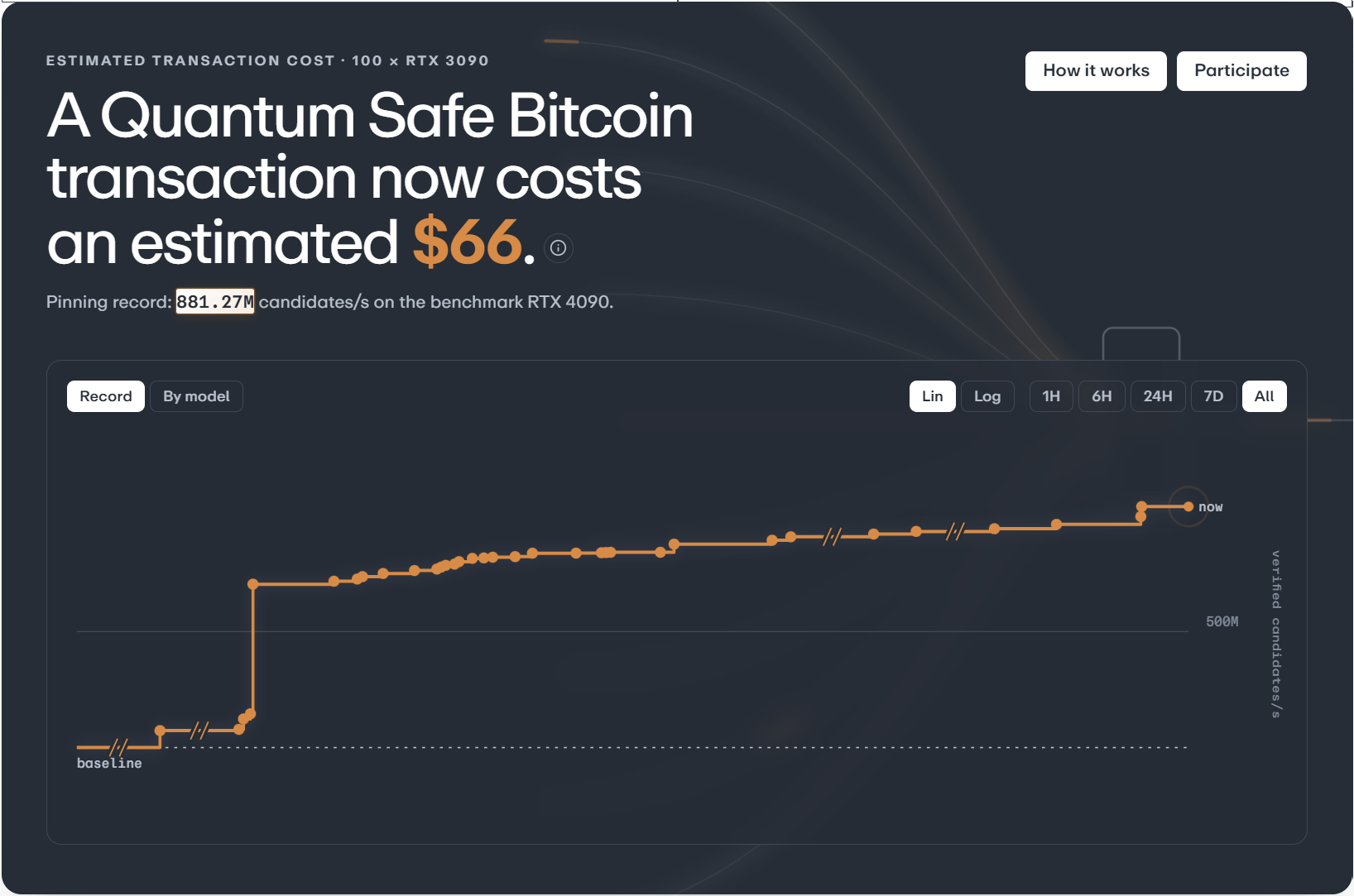
The estimated cost fell by another dollar since publication. Source: Yukon
According to StarkWare, the first QSB transaction was mined and confirmed on Aug. 26, with engineering work from Tomer Giladi and direct submission through MARA’s Slipstream service. Preparing it required approximately 3,100 GPU-hours across roughly 100 GPUs, at a compute cost of about $320, excluding Bitcoin network fees.
Related: Crypto’s first quantum attack will look like unexplained breach: Quantus founder
To find ways to bring that cost down, StarkWare, Yukon Research and Eigen Labs launched the QSB challenge on Sept. 16, inviting developers, researchers and AI agents to make the transaction-building software faster and more efficient.
In its latest update, StarkWare said the challenge produced 62 accepted improvements across two computational tasks needed to prepare a QSB transaction. According to StarkWare, this ended up cutting the estimated computing cost by about 79%, based on benchmark tests.
The development comes amid increasing concern that a sufficiently powerful quantum computer could break the elliptic-curve digital signatures used by Bitcoin, potentially allowing attackers to steal coins whose public keys are exposed.
Researchers are developing quantum-resistant protections, including QSB. However, StarkWare said it still favors a soft fork — a change to Bitcoin’s consensus rules — as a better “long-term answer” for broad quantum protection on Bitcoin.
Magazine: A quantum roadmap would push Bitcoin much higher: Charles Edwards
