


Robinhood Chain’s trading surged more than twentyfold in three months as its operator captured nearly $46 million in network fees.
The Ethereum layer-2 network, launched on July 1, recorded $14.05 billion in tokenized stock trading volume during its first quarter, according to Bitwise’s Oct. 20 staking report.
Monthly volume climbed from $526 million in July to $2.21 billion in August before reaching $11.31 billion in September. The expansion helped the network generate $51.11 million in transaction fees during the quarter, with Robinhood retaining an estimated $45.93 million, or nearly 90%, before operating expenses.
The performance suggests that operating proprietary blockchains could become an increasingly attractive revenue opportunity for financial services companies, while raising questions about how much economic value Ethereum captures from activity conducted on networks built around it.
The growth has extended beyond Robinhood’s own trading operations.
According to Token Terminal, weekly decentralized exchange trading volume for tokenized stocks across the market rose 447% after Robinhood Chain’s launch, from an average of $627 million to $3.4 billion.
Meanwhile, the blockchain’s total value locked in decentralized finance has climbed above $1.14 billion, according to DeFiLlama, extending its growth from about $1.03 billion at the end of September.
The number of Robinhood Stock Tokens also doubled from 96 in July to 193 by September. Nvidia-linked tokens led quarterly trading with $2.5 billion, followed by SPY and SpaceX tokens with $1.55 billion and $1.51 billion, respectively.
Robinhood’s blockchain emerges as a new revenue opportunity
Robinhood’s rapid expansion is demonstrating how financial companies can generate additional income by controlling the infrastructure used to execute transactions.
Bitwise estimated that Robinhood retained $45.93 million of the $51.11 million collected during the third quarter, while the Arbitrum ecosystem received approximately $5.11 million for providing the underlying technology.
Ethereum, which provides settlement and data availability services, incurred just $69,170 in settlement fees from Robinhood Chain during the same period.
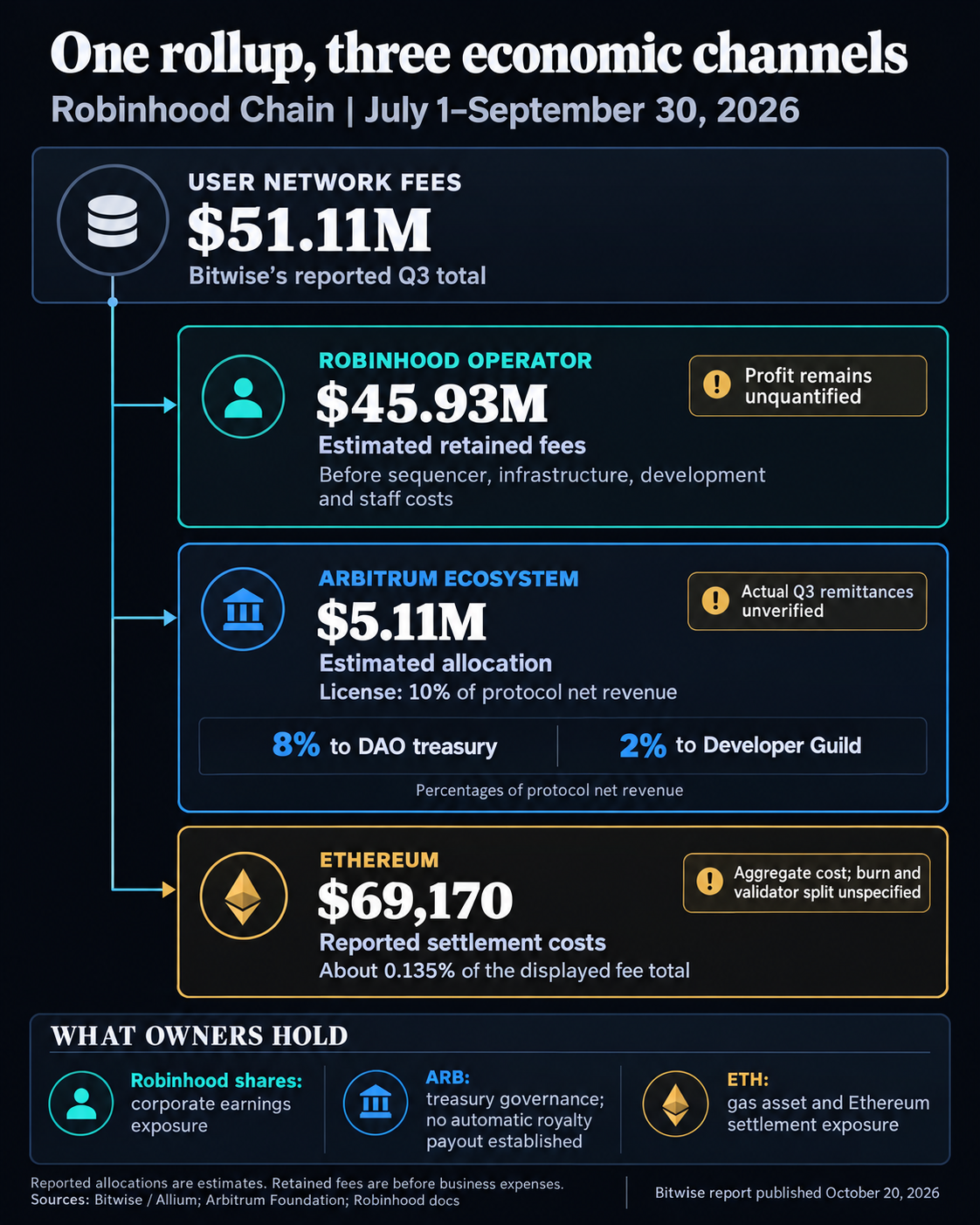
The arrangement allows Robinhood to retain most transaction fees while outsourcing parts of its blockchain infrastructure. Its retained revenue remains subject to infrastructure, development and other operating expenses.
The potential commercial opportunity is particularly significant given Robinhood’s existing financial business.
Token Terminal noted that the brokerage has a market valuation of roughly $100 billion and generates about $5 billion in annual revenue, positioning its blockchain operations as a potential additional source of earnings.
The analytics platform argued that as blockchain revenue becomes a larger share of Robinhood’s business, other financial services companies will increasingly consider launching their own networks.
That prospect comes as smaller Ethereum layer-2 operators like Abstract, Silicon, and Blast struggle to justify their operating costs.
As CryptoSlate previously reported, Abstract plans to shut down its network on Dec. 15 after stagnant growth, limited liquidity and weak revenue undermined its economics.
The network attracted more than 400,000 users and 144 applications, but its operator reported losing tens of millions of dollars supporting the business. Blast has also announced a shutdown after maintenance expenses exceeded revenue.
Robinhood enters that competitive market with an established brokerage, an existing customer base and financial products capable of generating transactions.
Its growing tokenized stock market and decentralized finance ecosystem offer a potential path to recurring revenue that independent blockchain operators have struggled to build.
Ethereum’s limited revenue share faces a sustainability test
Robinhood’s financial performance also exposes an emerging challenge for Ethereum as more activity shifts to secondary networks.
Despite Robinhood Chain collecting $51.11 million in user fees, its settlement costs represented just 0.135% of that amount. The overwhelming majority of transaction revenue remained with Robinhood and Arbitrum.
The disparity highlights how Ethereum’s scaling infrastructure can support substantial commercial activity without generating proportionate fees for the underlying blockchain.
That development coincides with declining Ethereum network revenue.
Bitwise reported that Ethereum generated $40.6 million in network fees and maximum extractable value during the third quarter, down from $63 million in the preceding three months.
The decline occurred despite Ethereum processing 35.3% more transactions than a year earlier, reflecting how greater network capacity and cheaper blockspace have weakened fee generation.
However, Robinhood’s own revenue growth faces a similar challenge as transaction costs normalize.
According to growthepie, approximately 74% of Robinhood Chain’s quarterly network fees were generated during a 12-day surge between Aug. 30 and Sept. 10.
Bitwise data showed September alone contributed $40.8 million, nearly 80% of the quarterly total, as average transaction costs rose from about two cents in July and August to 14.3 cents in September.
That concentration raises questions about whether the network can sustain its current revenue trajectory without another period of elevated trading activity and transaction fees.
Robinhood has already expanded its sustained transaction-processing capacity by 67% since launch, potentially supporting further growth as additional financial applications enter the network.
Bitwise also identified tokenized stock lending as a possible next source of activity, allowing investors to borrow against their holdings through decentralized finance platforms.
The coming quarter will test whether expanding trading and lending activity can offset lower transaction fees. Sustained revenue would strengthen the commercial case for proprietary blockchains, potentially encouraging other financial services companies to follow Robinhood’s strategy.
