

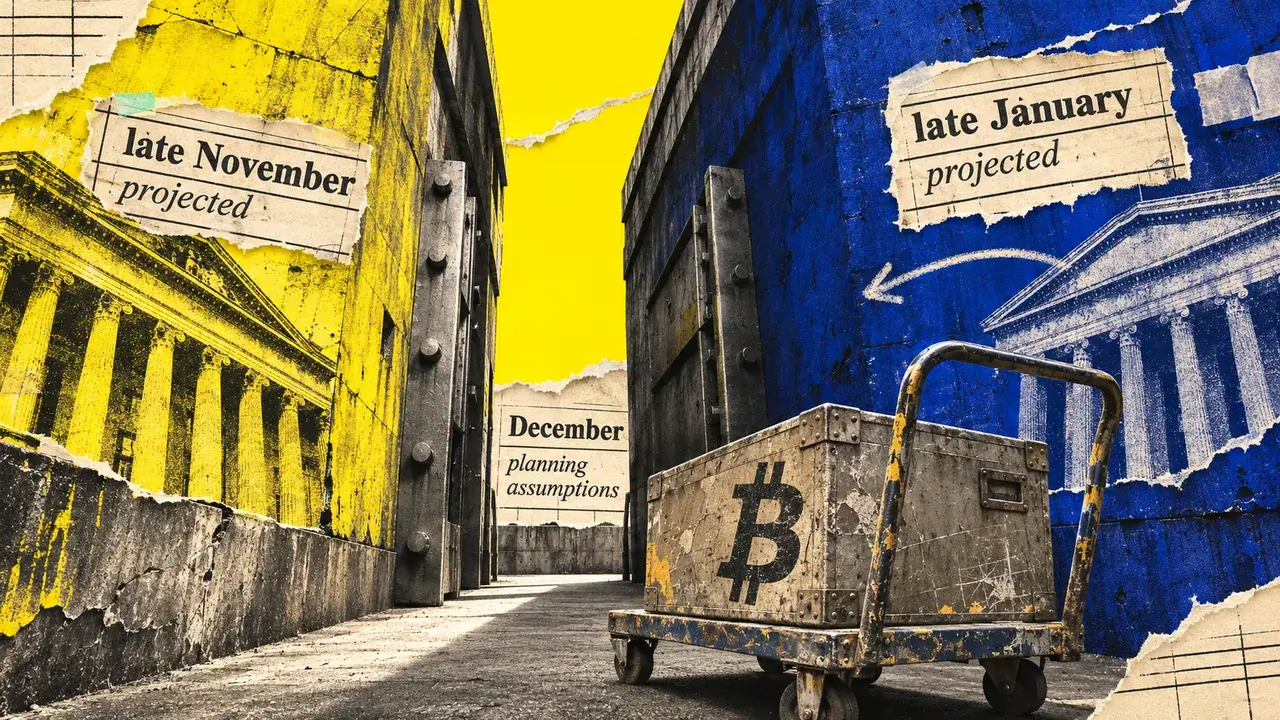
Treasury’s new financing calendar gives Bitcoin’s liquidity hopes a possible December window, with projected cash peaks on either side. Its Nov. 4 refunding statement anticipates cash peaks near $1,025 billion in late November and late January, with a lower balance assumed at December’s close.
That sequence sharpens the timing of potential reserve relief. If Treasury spends down its account at the Federal Reserve, it can return reserves to banks, all else equal. But the planned December reduction in bill auction sizes partly reflects expected tax receipts, which move cash the other way. That makes December’s net cash movement the first test of the funding case.
Two cash peaks frame December
In its refunding statement, Treasury estimates that the Treasury General Account, its operating account at the Fed, could peak at $1,025 billion, plus or minus $50 billion, in both late November 2026 and late January 2027. It assumes an $850 billion balance at the end of December.
The Nov. 2 borrowing estimates also assume a $1 trillion cash balance at the end of March 2027.
The bill schedule adds a seasonal mechanism. Treasury expects to maintain current benchmark bill auction sizes into late November and may issue a short-dated cash management bill around month-end. It then expects to reduce shorter-dated bill auction sizes during December, citing projected corporate and non-withheld tax receipts around the middle of the month.
January reverses that issuance direction: Treasury anticipates increasing auction sizes across the bill curve as seasonal fiscal outflows rise. It retains the ability to adjust those plans as borrowing needs change.
The paired cash peaks and bill sequence add timing within the refunding quarter to the quarter-end framework covered in CryptoSlate’s earlier Treasury analysis. A December respite could therefore sit inside a broader replenishment cycle rather than mark sustained easing.
Why fewer bills alone do not prove relief
Payments from Treasury’s Fed account support bank reserves, all else equal.
Tax receipts help explain December’s expected bill reductions, while cash entering Treasury’s account drains reserves, all else equal.
A cash drawdown can support reserves, all else equal. Lower bill auction sizes alone do not establish Bitcoin buying.
All future balances are projections or assumptions, not observations. Dates are not equally spaced in time. Tax receipts and other Fed balance-sheet changes can offset reserve support. No Bitcoin buying or price effect is established.
The Fed’s accounting explanation describes the reserve channel. Treasury payments transfer balances from its account into banks’ accounts at the central bank, increasing reserves, all else equal. Tax payments flowing into Treasury’s account drain those balances.
That distinction matters for December. Expected tax receipts help explain why Treasury can reduce bill auctions, but those receipts can also absorb reserves. Smaller auctions alone cannot establish that the combined cash flows will ease funding.
The realized net movement in Treasury’s account already incorporates financing, receipts and spending. Subtracting issuance again from that net cash change would count the financing effect twice. Fed securities purchases, lending and movements in currency, reverse repos or other deposits can also alter the final reserve total.
Nor should the refunding’s gross size be read as wholly new cash demand. Treasury plans to sell $125 billion against approximately $97 billion of privately held notes and bonds maturing Nov. 15, raising approximately $28 billion in new private cash. The three-year, ten-year and thirty-year auctions are scheduled for Nov. 9, 10 and 12, respectively. All settle Nov. 16, the relevant date for the cash exchange.
The December test for Bitcoin
Treasury’s latest reported closing cash balance was $938 billion on Nov. 3, according to its operating-cash data available early Nov. 5. The Secured Overnight Financing Rate, or SOFR, was 3.97% on Nov. 3, the latest date available in that release. It measures overnight borrowing against Treasury collateral.
The Fed’s Oct. 29 balance-sheet release reports bank reserves of about $2,895 billion on Wednesday, Oct. 28. The cash, reserve and rate figures provide dated baselines rather than a synchronized signal that funding has eased.
For Bitcoin, the useful test begins with actual Treasury cash movements, followed by the reserve and funding outcome after other Fed balance-sheet changes. Whether easier funding translates into Bitcoin buying remains a separate, unproven step.
A realized December cash decline alongside steadier reserves and easier funding would strengthen the temporary-relief case. A cash drawdown offset elsewhere on the Fed’s balance sheet would weaken it. Any December improvement could face another test if Treasury rebuilds cash toward its projected late-January peak while increasing bill auction sizes.
