
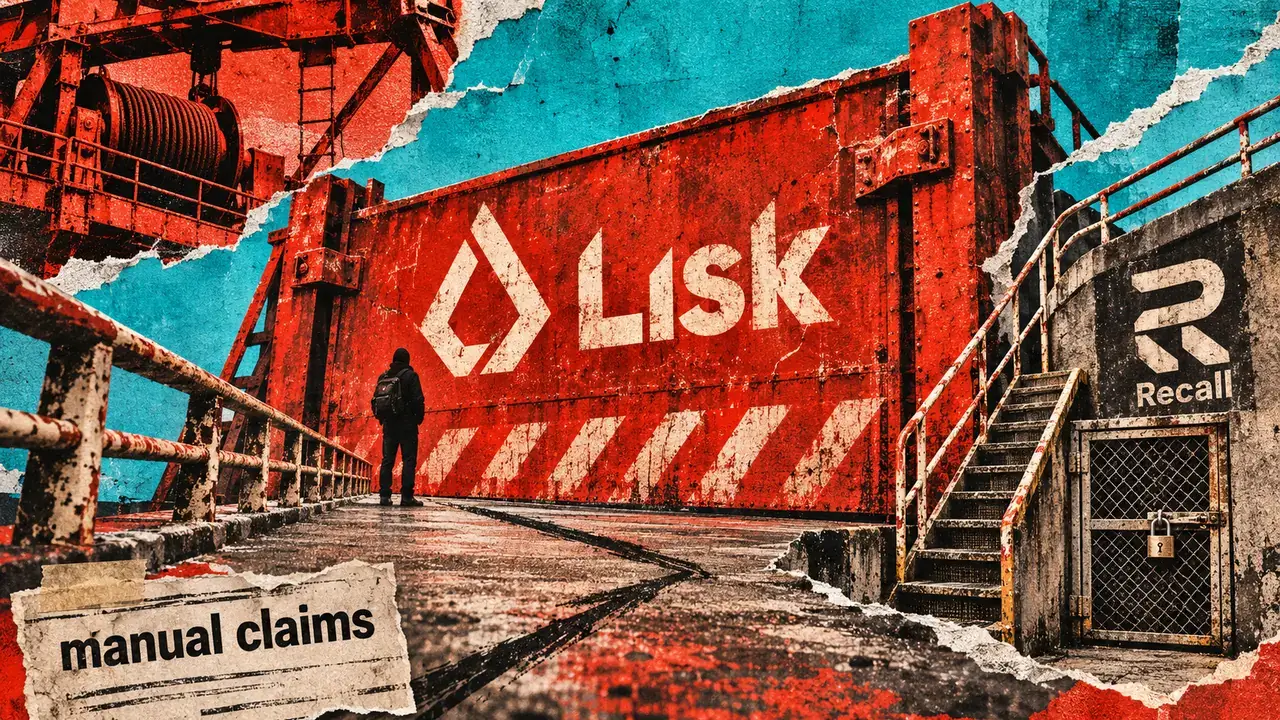
Lisk’s LSK token is continuing after its chain’s shutdown, but holders who left assets on its former Ethereum layer 2 network have lost its usual exit interface. The project says its portal and bridge closed on Nov. 2 and points remaining users to a manual claims process planned for January 2027.
Recall Foundation, which is winding down, describes a different path for staked RECALL. Its disclosure schedules its app to become read only on Nov. 30 and documents contract withdrawals afterward.
A surviving token, access to deposited assets and a share of an organization’s treasury carry different dependencies. A token balance does not, by itself, answer who must act to release funds or which infrastructure must keep operating.
A surviving token, recovery of a stake and a treasury distribution are separate questions.
January 2027 is a planned process-introduction month, with eligibility and mechanics unspecified. Recall’s route is Foundation-documented, not independently verified execution; original lockups and existing cooldowns apply, and Base execution is required.
Lisk’s remaining users await a new process
Lisk’s current claims FAQ says it plans to introduce manual claims in January and publish more details then. Eligibility, the steps holders must complete and the timing of any recovery remain unspecified; January is not a promised payment date.
The January proposal also concerns assets left on the later Lisk Chain. The FAQ separately says the legacy L1 claim window closed on May 21, 2026, and missed claims cannot be reimbursed. The January plan does not reopen those legacy claims.
Lisk itself continues as a business finance platform. It says LSK already held on Ethereum or exchanges was unaffected by the shutdown and its Ethereum contract remains unchanged. The location of a holding therefore matters even when the ticker is identical.
Its published guidance has changed. A September withdrawal notice used an Oct. 31 deadline and warned that no recovery process or claim window would follow shutdown. The current notice records the actual closure of user-facing services on Nov. 2 and offers the January plan. It describes the remaining chain infrastructure as being switched off afterward.
Before closure, Lisk’s instructions required stakers to unlock their positions, wait three days, unstake and then bridge to Ethereum. The instructions allowed approximately eight days for bridging, including a proof transaction and a final claim.
Founder Max Kordek’s strategy statement, labeled August and subsequently updated, describes the pivot to a business finance platform for accounts, payments and approvals. LSK continues as its loyalty token. The token FAQ says onchain governance ended with the DAO’s wind-down.
Principal and rewards also diverge. Lisk’s closure notice says about 5.2 million LSK in its rewards contract, including unassigned and earned but unclaimed rewards, will be burned after shutdown. It explicitly excludes LSK that users staked.
Recall documents an exit beyond its app
Recall Foundation’s Oct. 30 notice says its board acted independently of Recall Labs. The disclosure concerns the Foundation and its subsidiary Atlas Networks Limited.
Its instructions say holders initiate unstaking and withdrawal themselves, using the staking wallet and Base ETH for both transactions. Removing the cooldown for new requests from Oct. 30 does not shorten original lockups. Requests already in cooldown retain their original withdrawal dates.
The Foundation describes an exit that can outlast its app, while still requiring an operating Base network and successful contract transactions.
The Foundation excludes staked RECALL from its planned burn but promises no buyback, redemption or proportional treasury distribution. It assigns funds to creditors, wind-down costs and contingencies.
Earlier CryptoSlate reporting on Silicon showed that exit paths can differ by asset. Lisk and Recall make the dependency on the next actor especially clear: Lisk must still define its proposed process, while Recall’s published route requires holder action after applicable restrictions expire. Continued ownership alone completes neither exit.
